
Updated August 2026
Sarah’s 60×80 equipment storage building was three weeks from delivery when her contractor called with bad news. The foundation they’d planned wouldn’t work. The soil report revealed expansive clay requiring a completely different approach, adding $18,000 to the budget and delaying the project by six weeks.
“Nobody told me I needed a soil test,” Sarah said. “I thought all foundations were basically the same.”
They’re not. Your foundation represents roughly 15-25% of your total steel building project cost, and choosing the wrong type creates problems that are expensive to fix later. More importantly, your building’s structural warranty often depends on proper foundation design and installation.
The good news? Understanding your foundation options before you break ground prevents costly surprises and ensures your steel building performs exactly as engineered for decades to come.
Steel buildings place different demands on foundations than traditional wood frame construction. The concentrated load points where columns meet the ground create specific engineering requirements that standard residential foundation approaches don’t always address properly.
Every steel building foundation must accomplish three critical functions: distribute the building’s weight to prevent settling, resist uplift forces from wind and seismic activity, and maintain level support to preserve the building’s structural integrity. These aren’t just good practices; they’re essential for maintaining your manufacturer’s warranty and meeting building codes.
The foundation requirements for your specific project depend on several factors. Your building’s size and intended use determine the load calculations. A 40×60 agricultural storage building creates very different foundation demands than a 100×200 manufacturing facility with heavy equipment and crane systems.
Local soil conditions matter enormously. Sandy soils require a different foundation design than clay soils or bedrock. Areas with high water tables need additional drainage considerations. Regions experiencing freeze-thaw cycles must account for frost depth requirements to prevent heaving and cracking.
Your climate zone affects more than just frost depth. Seismic zones require additional anchoring provisions. Hurricane-prone areas need foundations engineered for substantial uplift resistance. Snow load regions may require deeper footers to support the additional roof load during winter months.
Building codes vary significantly by jurisdiction. Some municipalities accept engineer-engineered drawings without question. Others require extensive plan review and multiple inspections throughout the foundation installation process. Understanding your local requirements early prevents permit delays and ensures compliance.
Choosing the right foundation type balances performance requirements, soil conditions, budget constraints, and construction timeline. Each foundation type offers distinct advantages and limitations worth understanding before you commit to one approach.
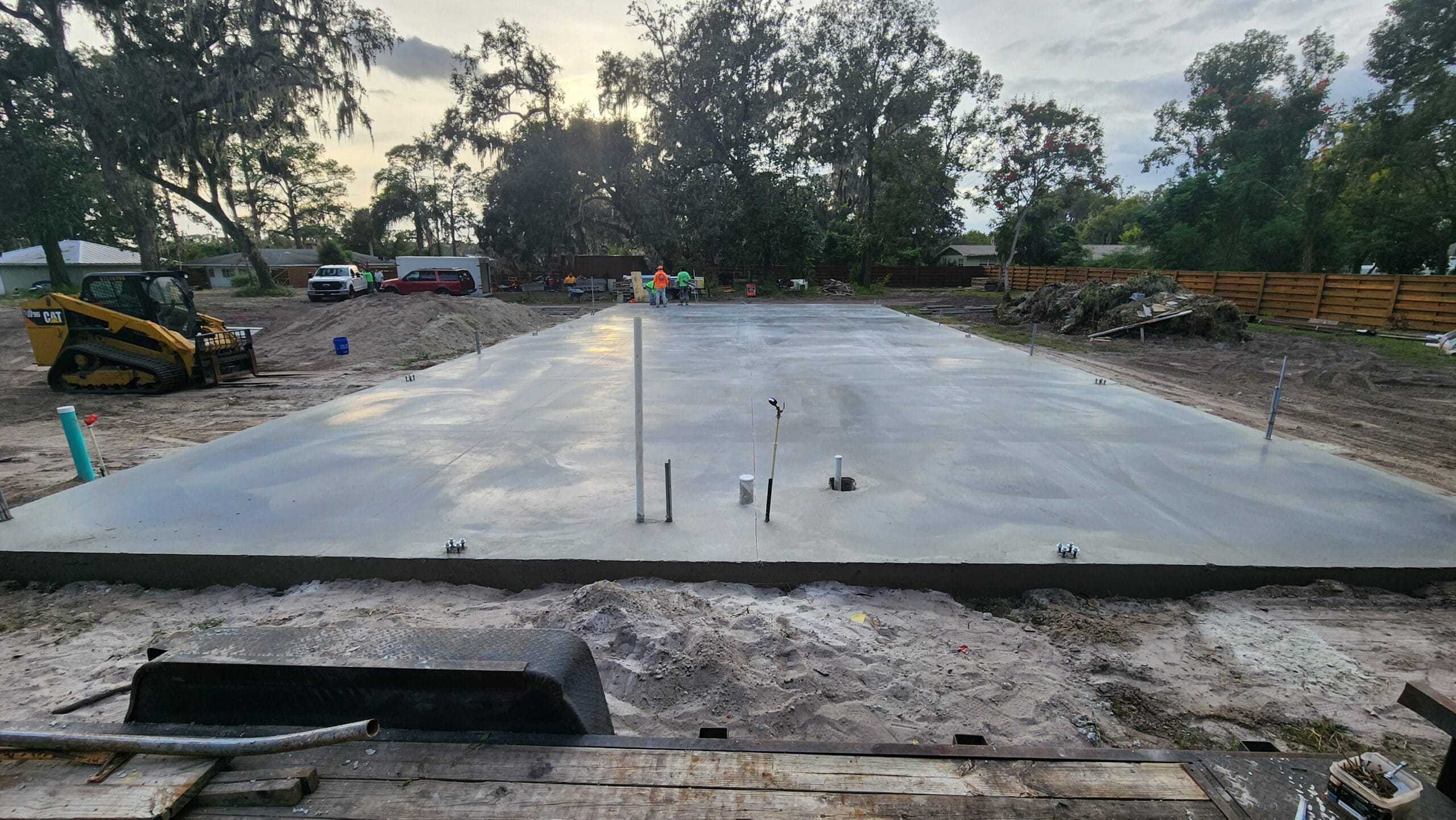
The concrete slab foundation represents the most common choice for steel buildings, and for good reason. A properly designed slab provides both the foundation and the floor system in a single pour, creating a cost-effective solution that works well for most applications.
Monolithic slab designs combine the footer and floor into one continuous pour. These work exceptionally well in stable soil conditions and warmer climates without deep frost concerns. The integrated approach reduces labor costs and construction time while creating a smooth, level surface ready for immediate use.
The slab typically requires 4-6 inches of thickness for most agricultural and commercial applications, though heavy equipment or vehicle traffic may justify 6-8 inches. Proper reinforcement using rebar or wire mesh prevents cracking as the concrete cures and settles. The edges thicken to 12-18 inches to create a footer that distributes the column loads effectively.
Proper site preparation makes the difference between a slab that lasts decades and one that cracks within months. The site must be excavated to remove organic material and unstable soils. A compacted gravel base, typically 4-6 inches deep, provides drainage and prevents settlement. Vapor barriers beneath the concrete prevent moisture migration that can damage stored materials or create condensation issues inside the building.
Modern slabs often incorporate insulation beneath the concrete in climate zones with significant heating or cooling requirements. This detail improves energy efficiency and comfort while preventing heat loss through the slab. The additional cost typically pays for itself through reduced utility bills over the building’s lifetime.
Anchor bolts embedded in the slab perimeter secure the building’s base angle to the foundation. These bolts must be precisely positioned according to the manufacturer’s anchor bolt plan. Even small positioning errors can create installation challenges or compromise the building’s structural performance. Many contractors use templates or jigs to ensure accurate placement during the pour.
Proper drainage around the slab prevents water accumulation that can undermine the foundation or create moisture problems inside the building. The site should slope away from the building in all directions. Gutters and downspouts should direct roof drainage well away from the foundation perimeter.
Slab foundations work exceptionally well for most steel building applications. They provide excellent value, quick construction, and reliable performance when properly designed and installed. The main limitations involve challenging soil conditions or sites with significant slope, where alternative foundation types may prove more practical.
Pier and beam foundations elevate the building above ground level using concrete piers or poured columns that support the steel structure. This approach offers significant advantages in specific situations where slab foundations prove impractical or unnecessarily expensive.
The pier system places concrete supports directly beneath each column load point. These piers extend below the frost line and bear on stable soil or bedrock. The building’s steel columns attach to anchor bolts embedded in the pier tops, creating a solid connection that transfers loads efficiently.
This foundation type excels in areas with problematic soils. Expansive clays that wreak havoc on slabs cause minimal issues with pier foundations since the piers can be designed to move slightly with soil expansion and contraction. Sites with high water tables or seasonal flooding benefit from the elevated design that keeps the building above potential water damage.
Sloped sites often make pier foundations the most economical choice. Cutting and filling to create a level building pad for a slab foundation becomes expensive on steep terrain. Piers can accommodate grade changes efficiently, following the natural topography while maintaining proper building elevation.
The elevated design creates a crawl space beneath the building that provides several benefits. Utilities can route through this space easily, simplifying plumbing, electrical, and HVAC installations. The airflow beneath the building reduces moisture accumulation and allows for natural ventilation. Future modifications or repairs become simpler when systems remain accessible.
However, pier foundations require additional consideration for the floor system. Most applications need a separate floor structure, typically using wood joists and plywood decking or concrete slab on grade between the piers. This additional component adds cost compared to slab foundations where the floor and foundation integrate into one system.
The spacing between piers depends on your building’s column spacing and load requirements. Typical spacing ranges from 20 to 40 feet, determined by your building’s engineering. Each pier requires excavation, forms, rebar reinforcement, and concrete placement. The labor-intensive process takes more time than pouring a single slab.
Frost depth requirements still apply to pier foundations. In cold climates, piers must extend below the frost line to prevent heaving. This depth varies by location, from 12 inches in southern regions to 48 inches or more in northern climates. Local building codes specify the required depth for your area.
Stem wall foundations combine elements of both slab and pier approaches, creating a hybrid system that works well in specific applications. This foundation type uses a continuous perimeter wall that sits on a concrete footer, with the interior floor area filled to create a slab surface.
The construction process begins with trenching around the building perimeter to the required depth for your climate and soil conditions. A concrete footer, typically 12-24 inches wide and 8-12 inches thick, pours in these trenches to create the base for the stem wall. Rebar reinforcement in the footer provides tensile strength and prevents cracking.
The stem wall itself rises from the footer to the desired floor elevation. This wall is typically 8-12 inches wide, constructed using either poured concrete or concrete masonry units (CMU blocks). The height varies based on site conditions, grade requirements, and your preference for how far above ground level the building sits.
Once the stem wall cures, the interior area fills with compacted gravel, and the floor slab pours inside the perimeter. This approach creates a monolithic floor similar to a standard slab foundation but with the added benefits of the elevated, reinforced perimeter wall.
Stem wall foundations excel in areas with moderate frost concerns where a full basement isn’t necessary but some protection from frost heaving is desirable. The design also works well on slightly sloped sites where a stem wall can accommodate grade changes more easily than a monolithic slab.
The perimeter wall provides excellent protection against water intrusion, creating a barrier between exterior grade and the interior floor. Proper waterproofing on the exterior wall face, combined with foundation drains, keeps water away from the building interior even in wet climates.
This foundation type costs more than simple slab foundations due to the additional excavation, forming, and concrete work required for the stem wall. However, it typically costs less than pier and beam systems while offering some similar benefits. The additional expense often justifies itself in challenging site conditions or when the elevated perimeter provides specific advantages for your application.
People search for “metal building foundation,” “steel building foundations,” and “steel frame building foundations,” and they all describe the same thing: the concrete base that anchors a pre-engineered steel structure. The wording does not change the engineering. Whether you call it a metal building or a steel frame building, the foundation still has to match your soil, your loads, and your local code. The slab, pier and beam, and stem wall options covered above apply to all of them, and MBMI engineers each foundation for the specific building it will carry.
Understanding foundation costs helps you budget accurately and make informed decisions about design options. While every project differs based on size, location, and specific requirements, some general cost ranges provide useful planning guidance.
Concrete slab foundations typically range from $4 to $8 per square foot for basic installations in straightforward soil conditions. A 60×80 building (4,800 square feet) might cost $19,200 to $38,400 for the slab foundation. This wide range reflects regional labor cost differences, concrete prices, and site-specific factors like accessibility and site preparation requirements.
The basic slab cost includes site excavation, gravel base, vapor barrier, concrete, reinforcement, and finishing. Additional features increase the total cost. Thickened edges for heavy loads, perimeter insulation for energy efficiency, embedded radiant heating systems, and decorative finishes all add to the base price. Factor these options into your initial budget planning rather than discovering cost overruns during construction.
Pier and beam foundations cost varies with the number of piers required and the depth needed for your frost line and soil conditions. Individual piers typically cost $200 to $600 each including excavation, forms, concrete, and rebar. A building requiring 20 piers might need $4,000 to $12,000 just for the pier work. Add the cost of a separate floor system, and total foundation costs often exceed slab foundations by 30-50%.
Stem wall foundations generally cost 25-40% more than simple slabs due to the additional forming, concrete, and labor. Using the same 60×80 building example, expect foundation costs between $24,000 and $48,000. The premium buys specific advantages in frost protection, water management, and grade accommodation.
Site conditions dramatically affect foundation costs. Poor soils requiring removal and replacement, high water tables needing drainage systems, or rocky conditions requiring special excavation equipment all increase expenses significantly. Budget for a professional soil test early in planning. The $500-1,500 investment in soil testing often saves thousands by identifying problems before construction begins.
Permitting and engineering fees add to foundation costs. Most jurisdictions require engineered foundation plans for commercial structures. Engineering fees typically range from $500 to $2,000 depending on project complexity. Building permits vary widely by location but generally cost 1-3% of construction value. Some areas also require separate foundation inspections at multiple stages, adding inspector fees to your budget.
Regional factors create significant cost variations. Urban areas with higher labor rates and strict permitting processes typically cost more than rural areas. Areas with winter construction limitations may charge premium rates for cold-weather concrete work. Coastal regions often require additional engineering for soil and wind conditions, increasing design costs.
Smart builders obtain multiple quotes from qualified concrete contractors. Price differences of 20-30% between contractors aren’t unusual. However, foundation work isn’t the place to automatically choose the lowest bidder. Poor foundation installation creates problems that cost far more to correct than you saved initially. Check references, verify proper licensing and insurance, and ensure contractors understand steel building foundation requirements specifically.
Your foundation’s performance depends heavily on what lies beneath it. Skipping proper soil testing ranks among the most common and costly mistakes in steel building construction. Professional soil analysis identifies conditions affecting foundation design and reveals potential problems before they become expensive failures.
A geotechnical engineer conducts soil testing by taking samples at various depths across your building site. The testing analyzes soil composition, bearing capacity, moisture content, and expansion potential. The resulting soil report provides specific recommendations for foundation design, including required depths, reinforcement needs, and special provisions for challenging conditions.
Soil bearing capacity determines how much weight the soil can support without excessive settlement. Sandy and gravelly soils typically offer excellent bearing capacity, often supporting 2,000-3,000 pounds per square foot or more. Clay soils vary dramatically, with some types supporting substantial loads while others compress significantly under weight. The soil report specifies the bearing capacity your foundation design must accommodate.
Expansive soils present particular challenges for steel buildings. These clay-based soils swell significantly when wet and shrink when dry, creating movement that can crack slabs, shift piers, and stress building connections. The soil report identifies expansion potential and recommends mitigation strategies like deeper foundations, flexible connections, or soil stabilization.
High water tables require special attention in foundation design. Standing water or saturated soils reduce bearing capacity and can cause settlement issues. The foundation may need to extend deeper to reach more stable soil, or the design might incorporate drainage systems to lower the water table around the foundation. In extreme cases, the site may require filling to raise the building above problematic water levels.
Frost depth requirements vary by climate zone. Soil expands when moisture freezes, creating powerful heaving forces that can lift and crack foundations. Your foundation must extend below the maximum frost penetration depth for your area. This depth ranges from zero in frost-free southern climates to 48 inches or more in northern regions. Local building codes specify required frost depths.
Proper site preparation begins before concrete work starts. Clear the building area of vegetation, topsoil, and debris. Organic materials decompose over time, creating voids beneath foundations that lead to settlement. Remove all organic matter and unstable soils, replacing them with compacted structural fill when necessary.
Rough grading establishes proper drainage patterns and creates the level building pad your foundation requires. The site should slope away from the building in all directions to prevent water accumulation. In some cases, swales or drainage systems may be necessary to manage water flow across the property.
Compaction of base materials critically affects foundation performance. The gravel base beneath a slab foundation must be thoroughly compacted to prevent settlement. Each lift of gravel should be 4-6 inches thick and compacted to at least 95% of maximum density before adding the next lift. Renting a plate compactor or vibratory roller ensures proper compaction that hand tamping cannot achieve.
Steel building foundations require engineering that accounts for the unique load patterns and connection requirements of pre-engineered metal buildings. Your building manufacturer provides engineering drawings showing exact anchor bolt locations, load reactions at each column, and specific foundation requirements.
The anchor bolt plan forms the critical connection between foundation and building. These drawings show precise dimensions locating each anchor bolt relative to the building’s grid lines. Position accuracy matters enormously because the building’s base angle must align perfectly with the anchor bolts during erection. Positioning errors of even an inch can prevent proper installation or create stress concentrations that affect structural performance.
Foundation drawings specify concrete strength requirements, typically 3,000 to 4,000 PSI for most steel building applications. Higher strength concrete costs more but provides greater durability and load capacity. Understanding proper concrete mix design and curing procedures ensures your foundation meets these specifications. The specified strength isn’t optional; your building’s engineering assumes the foundation meets these requirements. Using lower strength concrete voids warranties and creates liability issues.
Reinforcement specifications ensure the foundation resists cracking and distributes loads properly. Rebar placement, sizing, and spacing all follow engineering requirements. Wire mesh offers adequate reinforcement for light-duty slabs, but heavier applications require rebar grids. The steel reinforcement must be properly positioned within the concrete, typically 2-3 inches from the bottom surface for effective tension resistance.
Local building codes overlay manufacturer requirements with additional jurisdiction-specific provisions. Some areas require deeper frost footings than standard engineering assumes. Seismic zones mandate special anchoring provisions. Hurricane regions need enhanced uplift resistance. Your foundation design must satisfy both the manufacturer’s engineering and local code requirements.
The building permit process verifies code compliance before construction begins. Submit foundation plans to your local building department, allowing adequate time for review. Plan review can take anywhere from a few days to several weeks, depending on department workload and project complexity. Don’t schedule concrete work until you receive permit approval.
Foundation inspections occur at specific construction stages. Most jurisdictions require inspection of excavation and formwork before concrete placement, ensuring proper depth, dimensions, and anchor bolt positioning. A second inspection verifies the completed foundation meets approved plans. Schedule inspections in advance and don’t proceed to the next construction phase until receiving approval.
Working with qualified professionals ensures code compliance and proper engineering. Use concrete contractors experienced specifically with steel building foundations. The precise anchor bolt positioning and unique load patterns differ from residential work. Contractors familiar with metal buildings understand these requirements and avoid common installation errors.
Consider hiring a third-party inspection service for additional quality assurance. These professional inspectors verify proper installation techniques, correct material usage, and compliance with engineering specifications. The modest cost often prevents expensive problems discovered during final building inspection or, worse, after the building is complete.
Even with proper planning, certain mistakes occur frequently enough to warrant special attention. Avoiding these errors saves time, money, and frustration.
Skipping soil testing to save a few hundred dollars often leads to foundation failures costing thousands to correct. Unknown soil conditions create problems that proper testing identifies before construction begins.
Incorrect anchor bolt positioning prevents proper building alignment during erection. The steel structure can’t compensate for positioning errors. Use templates or jigs to ensure accuracy.
Inadequate drainage allows water to undermine foundations and create interior moisture problems. Grade sites to slope away from buildings and install proper roof drainage systems.
Using lower concrete strength than specified compromises load capacity and durability. Always order the specified strength and verify with delivery tickets.
Insufficient base compaction leads to settlement and cracking. Thoroughly compact each lift of gravel base before adding more material.
Ignoring frost depth requirements causes foundation heaving in cold climates. Extend footings below maximum frost penetration depth as specified by local codes.
Starting without permits creates legal liability and can require removing completed work. Always obtain proper permits before beginning foundation work.
Poor construction timing in extreme weather affects concrete curing. Plan foundation work for appropriate conditions and use proper hot-weather or cold-weather concrete practices when necessary.
Do I really need a soil test for my steel building foundation?
Yes, professional soil testing is essential for proper foundation design. Soil conditions vary dramatically even within small areas, and unexpected problems like expansive clay or poor bearing capacity can cause foundation failures. The $500-1,500 investment in soil testing often prevents thousands in repair costs by identifying issues before construction begins.
How thick should my concrete slab be for a steel building?
Most agricultural and light commercial steel buildings require 4-6 inches of concrete slab thickness. Buildings with heavy equipment, vehicle traffic, or substantial storage loads may need 6-8 inches. Your building’s engineering specifies the required thickness based on your intended use and load requirements. The thickened perimeter footer is typically 12-18 inches deep to distribute column loads properly.
Can I use an existing slab for my new steel building?
Existing slabs can work if they meet several criteria. The slab must be level, structurally sound without significant cracking or settlement, properly sized for your new building, and have anchor points positioned to match your building’s column layout. Most existing slabs don’t meet all requirements, particularly the critical anchor bolt positioning. Have your building manufacturer’s engineer evaluate the existing slab before assuming it’s suitable.
What’s the difference between a monolithic slab and a floating slab?
A monolithic slab combines the footer and floor into one continuous pour, with thickened edges around the perimeter that extend below frost line. A floating slab sits on top of the ground on a gravel base without deep footers. Monolithic slabs work for most steel building applications in stable soils. Floating slabs may be suitable for temporary structures or very light buildings in frost-free climates but typically aren’t appropriate for permanent steel buildings.
How long does concrete need to cure before building erection?
Concrete reaches approximately 70% of its final strength in seven days and 90% in 28 days. Most steel building erection can proceed safely after 7-10 days of curing in normal weather conditions. However, anchor bolts must not be disturbed during curing, and any column loads should wait until the concrete reaches adequate strength. Your building manufacturer and concrete contractor can provide specific timing recommendations for your project.
Do I need a vapor barrier under my concrete slab?
Yes, vapor barriers are essential beneath concrete slabs to prevent moisture migration from the ground into your building. Place a 6-mil polyethylene sheet or specialized vapor barrier over the compacted gravel base before pouring concrete. Overlap seams by 12 inches and seal with tape. This simple step prevents condensation problems and protects stored materials from ground moisture.
Your steel building deserves a foundation engineered for long-term performance and value. The choices you make during foundation planning affect your building’s structural integrity, warranty compliance, and total project cost.
Start by obtaining professional soil testing to understand your site conditions. Work with qualified engineers to design a foundation appropriate for your specific application. Choose experienced contractors familiar with steel building foundations, and ensure all work receives proper permits and inspections.
Ready to start planning your steel building project? Get real numbers and price out your project with our engineered calculator.