
TL;DR: Three decisions define a hangar: clear-span width (drives column placement and door size), door type (bi-fold vs. hydraulic), and tail clearance (drives interior height). Get those three right and the rest is finish detail.
An aircraft hangar is a commercial steel building designed to store, maintain, or service aircraft, with structural and door requirements distinct from a standard commercial building.
The defining feature is the absence of interior columns across the door opening, which forces a clear-span structural design that drives both the cost and the engineering. Beyond the obvious requirement of fitting the aircraft, hangar design has to handle ground handling movements, fuel and oil containment, ventilation for piston aircraft, and access for maintenance lifts.
This guide walks through the three decisions that drive 80% of the design and the supporting choices that determine whether the aircraft hangar design you order can actually hold and service the aircraft you have.
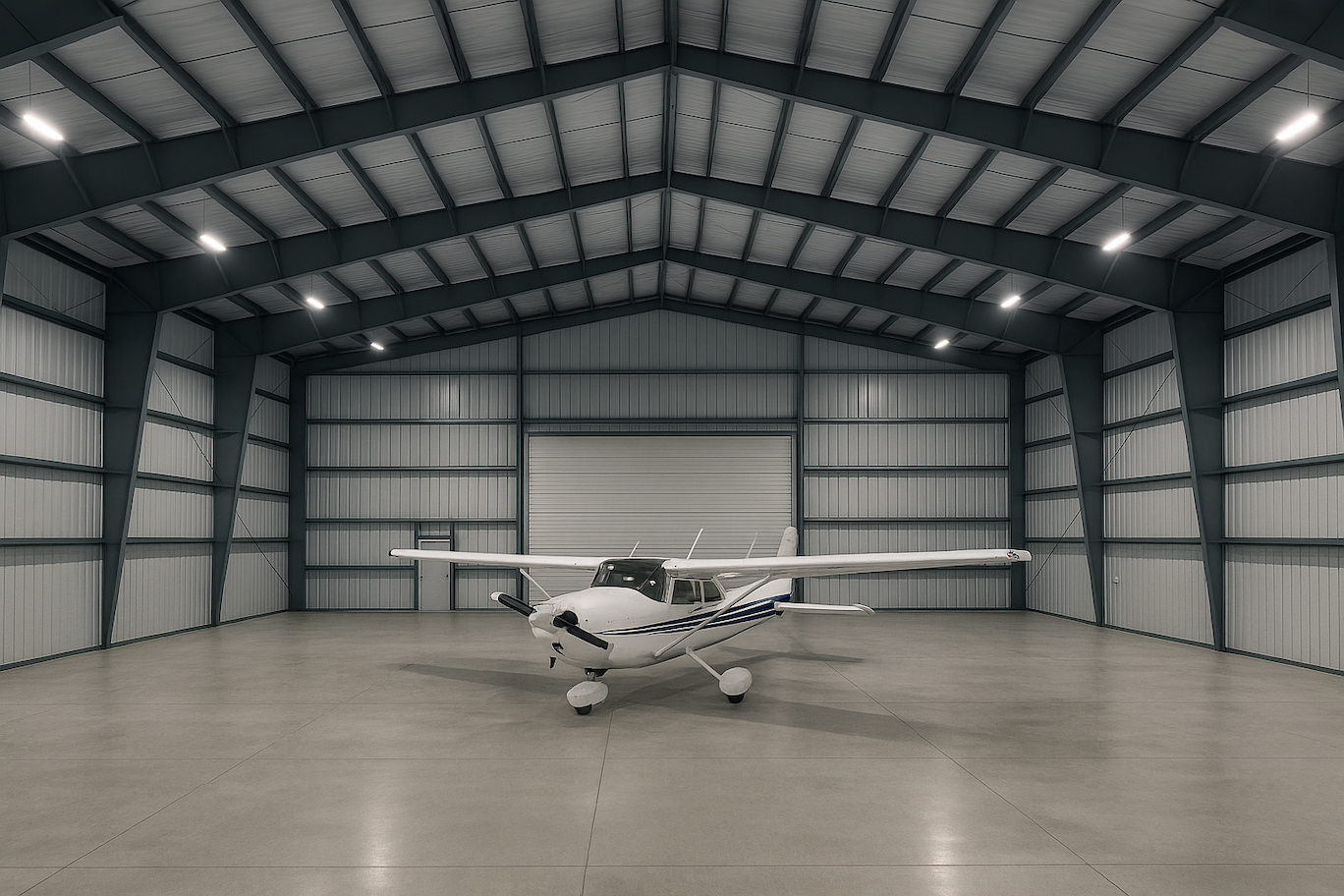
The clear-span width is the unobstructed horizontal distance across the door opening. It has to accommodate the aircraft’s wingspan plus tip clearance for ground movement, typically 4 to 8 feet beyond the wingtip on each side. A single Cessna 172 (36-foot wingspan) fits in a 50-foot clear span.
A Cirrus SR22 (38-foot wingspan) is similar. Twin-engine pistons like a Beechcraft Baron (38 to 45 feet) push toward 55-foot spans. Turboprops and small jets typically need 60 to 80 feet.
The pre-engineered steel frame handles clear spans up to about 150 feet without internal columns, which covers everything short of large commercial aircraft. Above 100 feet the engineering becomes more expensive but remains buildable. Most general aviation hangars sit in the 50 to 80-foot range.
The hangar door is the single largest moving component and one of the largest line items in the budget. Three common types:
Bi-fold doors fold in the middle, opening from the bottom up. Cables and a motor lift them in 30-90 seconds. They’re the most common choice for general aviation hangars from 40 to 100 feet wide.
Strengths: relatively low cost per square foot of opening, well-known maintenance, available in nearly any width. Weakness: the folded door slightly reduces top-of-door clearance, which matters for tall tails.
Hydraulic doors lift as a single panel from the bottom hinge, opening like an awning. They open faster (15-45 seconds), have no overhead clearance penalty when open, and provide weather protection over the front of the hangar when partially open. Strengths: clear vertical opening, weather canopy, smooth single-panel aesthetics. Weakness: higher initial cost, more complex hydraulics to maintain.
Sliding doors roll horizontally on tracks. Common for older or budget builds. Strengths: lowest cost, simple mechanics. Weakness: track and roller maintenance, slower operation, doesn’t seal as well as bi-fold or hydraulic.
For a typical general aviation single-aircraft hangar, bi-fold is the default choice. For corporate hangars, FBO bays, or hangars storing tall-tail aircraft, hydraulic is increasingly the standard. Both are available as engineered packages with the MBMI commercial metal buildings lineup.
Interior height is driven by the aircraft’s vertical tail height plus working clearance overhead. A Cessna 172 stands 8’11” at the rudder tip. A Cirrus SR22 is similar. Twin-engine pistons push toward 11-13 feet.
Turboprops like a King Air are 14-15 feet. Small business jets like a Citation Mustang are around 13-14 feet. Light bizjets like a Phenom 300 or Citation XLS push 15-16 feet.
Standard practice adds 3-5 feet of overhead clearance beyond the tail height to allow safe ground handling, lift access for maintenance, and hangar door operation. A hangar housing a Cessna 172 typically targets 14-16 feet of interior eave height. Hangars for King Air or light jets target 18-22 feet.
If you’re planning for future aircraft upgrade, build for the future plane, not the current one. Adding 2 feet of eave height at order is a small cost; adding it later means re-engineering or replacement.
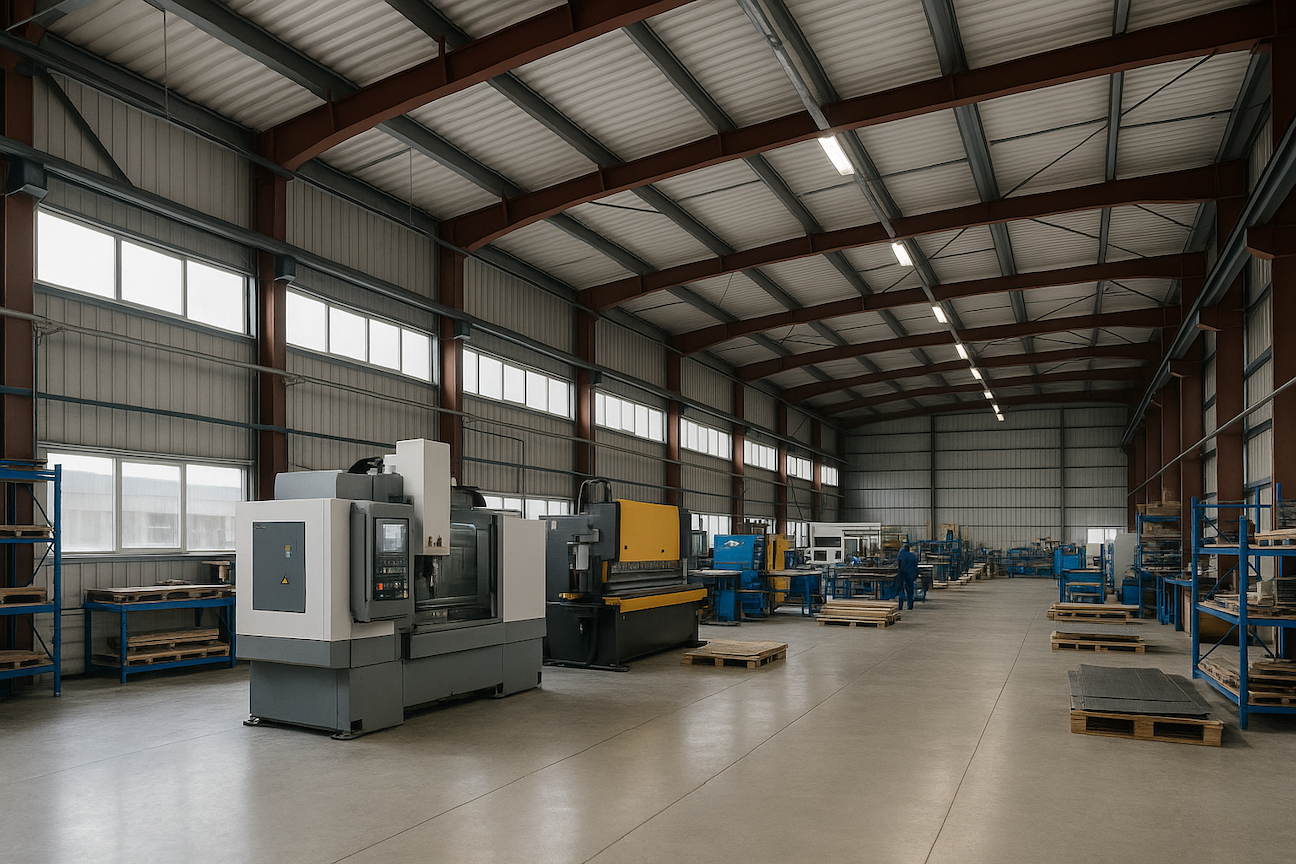
Most hangars need more room than the aircraft alone. Plan for:
Total square footage typically runs 1.4 to 1.8 times the aircraft footprint for a working hangar. A 36-foot wingspan, 27-foot length aircraft (Cessna 172) needs roughly 50×70 = 3,500 sq ft for a comfortable hangar with workspace. Bare minimum is closer to 50×40 = 2,000 sq ft, which limits maintenance access.
Aircraft hangars need a flat, smooth, sealed concrete floor. Typical specs: 6-inch slab with rebar, sealer or epoxy coating for fuel and oil resistance, fall and grade for liquid drainage to a containment, and aircraft grounding points embedded in the slab at the typical parking position. The slab work alone is a significant line item; budget $8 to $15 per square foot depending on local concrete and prep work.
Aircraft hangar fire code varies with size and use. The applicable code is NFPA 409 for hangars over 12,000 sq ft, with progressively more stringent fire suppression requirements as size increases. Smaller private hangars often need only fire extinguishers, hangar exit signage, and clear access.
Larger hangars (over 12,000 sq ft, or commercial use) may require deluge fire suppression, foam systems, or smoke detection. Confirm with the local fire marshal before finalizing the design.
Piston aircraft burn 100LL avgas, which has lead content and produces fumes during run-up. Turbines burn Jet A. Both require hangar ventilation, especially for hangars where engines are started or run inside.
Cross-ventilation with passive vents in the roof and walls handles general aviation use. Larger hangars with regular run-ups need powered exhaust.
Hangars in hot or cold climates need insulation for aircraft preservation, comfort during maintenance, and protection of avionics. Continuous insulation behind the wall panels is the standard approach. Full HVAC is expensive for a hangar because of the door opening; targeted heating for the maintenance area and a workbench is a common middle ground.
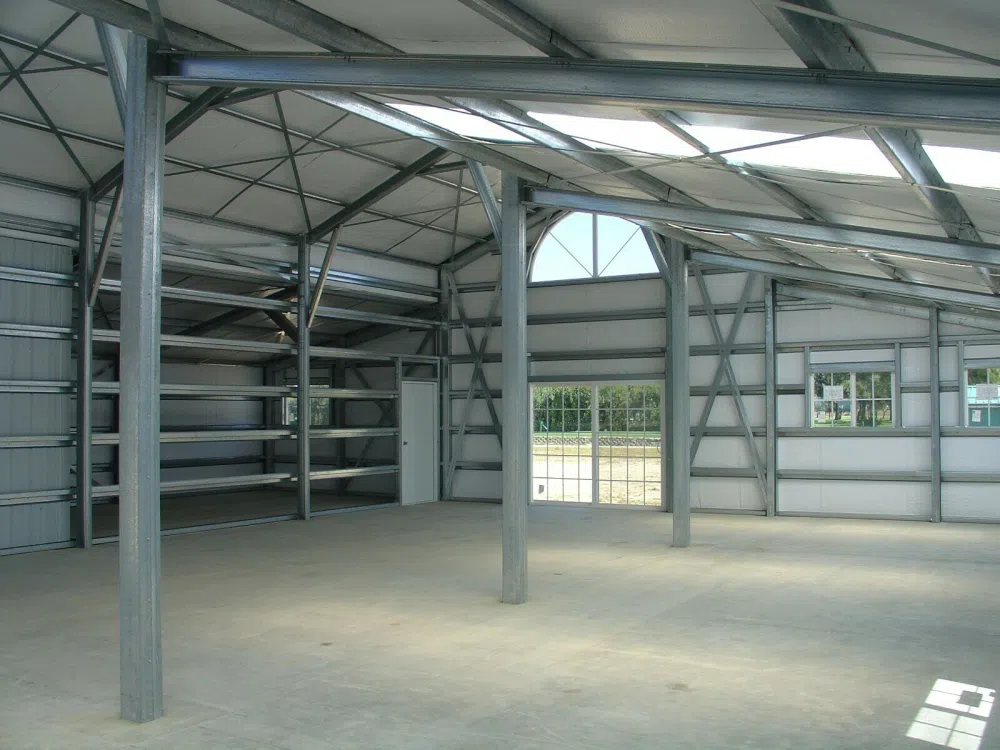
Most common. 50×60 to 60×80 footprint, bi-fold door, modest workspace, no fire suppression. Owner-pilot use. Budget reasonable for the build; integrate into local airport’s leasing rules.
100×100 to 150×200 or larger, hydraulic doors, full maintenance area, fire suppression to code. Commercial occupancy classification. The engineering and code package is more complex; the structural system remains pre-engineered steel.
Engineered for the largest aircraft the operator services, with crane loads, maintenance lifts, parts storage, and full code compliance. The hangar shell is the start; the interior fit-out drives the project budget.
Crop dusters, helicopters, ag-aviation operators. Smaller footprint, sometimes with attached chemical storage (which has its own code requirements). Hangar shell is straightforward; supporting use cases drive permits.
A specific quote based on these inputs returns a buildable engineered package. The MBMI free steel building estimate form is the input side; specifying door type, eave height, and intended aircraft size in the inquiry returns an aligned package.
A general aviation single-aircraft hangar (50×60, bi-fold door, modest finish) typically runs $80,000 to $150,000 for the building shell. Add foundation, electrical, door equipment, and finishes; turn-key costs typically range $180,000 to $300,000. Corporate or commercial hangars run substantially more depending on size and code requirements.
Bi-fold is the default for general aviation under 80 feet wide. Hydraulic is preferred when tail clearance is tight or weather canopy is wanted. Both are reliable; the choice is cost and operational preference.
Interior eave height is typically tail height plus 3-5 feet of clearance. A Cessna 172 hangar targets 14-16 feet. A King Air targets 18-22 feet. Light jets target 18-24 feet.
Yes. Pre-engineered steel hangars meet NFPA 409 with the appropriate fire suppression package for the size and use. Confirm with the local fire marshal during design; the engineering and code package is part of the engineered building order.
For a simple private hangar, the pre-engineered package often satisfies the building department without a separate architect. For corporate hangars, MRO facilities, or any project with mixed occupancy, an architect and a code consultant are typically required and worth the cost.