
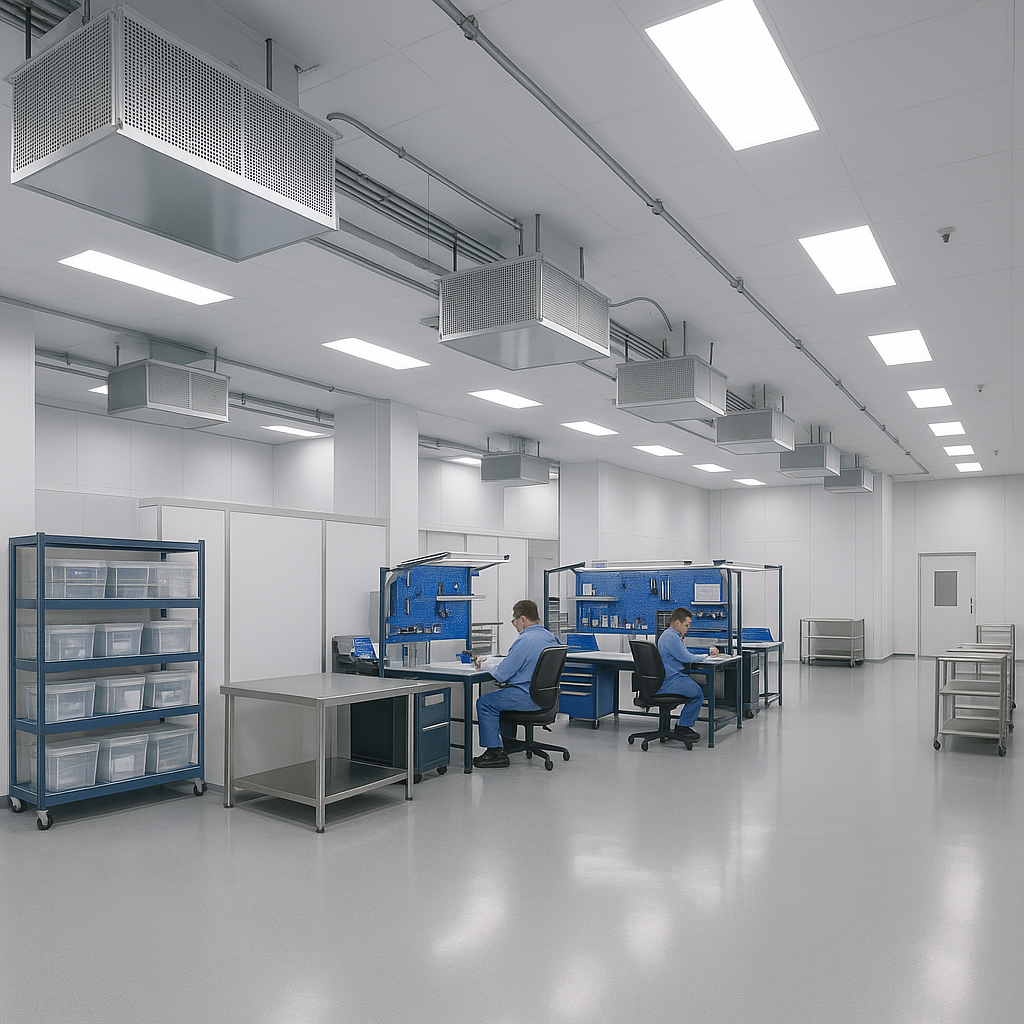
A distribution center in Georgia made one change during a facility upgrade and cut its lighting energy bill by 61%. They didn’t add solar panels or overhaul their electrical system. They switched from metal halide fixtures to LED high-bay lighting and added daylight sensors that dimmed artificial lighting when natural light was sufficient.
The building was a metal structure with translucent roof panels along the ridge. Natural light had been pouring in for years while the old fixtures ran at full power regardless. The sensors simply connected two things that were already there.
Lighting decisions in commercial and industrial metal buildings carry more financial weight than most business owners realize. Lighting accounts for 20-30% of commercial energy consumption, and industrial facilities with high-bay requirements often run toward the higher end of that range. Getting the strategy right from the start, or improving it during renovation, delivers returns that compound year after year.
Metal halide and fluorescent fixtures dominated industrial lighting for decades. They’re familiar, widely available, and well understood. They’re also increasingly obsolete for commercial applications where energy costs, maintenance burdens, and light quality all matter to operations.
LED high-bay fixtures now outperform traditional alternatives on nearly every relevant measure. Energy consumption runs 40-60% lower than equivalent metal halide systems. Fixture life extends to 50,000-100,000 hours compared to 10,000-20,000 hours for metal halide, dramatically reducing replacement frequency and associated maintenance costs. LED fixtures reach full brightness instantly without the warm-up period that metal halide requires, which matters in facilities where lights are cycled on and off throughout the day.
Light quality improvements are meaningful in working environments. LED fixtures provide consistent color rendering that makes it easier to read labels, identify products, and perform quality control. Metal halide light shifts color as fixtures age, creating inconsistent illumination that workers adapt to without realizing how much it affects their work. LED maintains consistent quality throughout its service life.
The economics favor LED so strongly that most new commercial and industrial facilities specify them as a matter of course. For existing facilities still running older technology, retrofit payback periods typically run two to four years, after which savings continue for the remaining fixture life.
Commercial metal buildings with ceiling heights above 15 feet require high-bay fixtures designed to project light effectively across significant distances. Choosing the right fixture type and mounting configuration determines whether your facility is well-lit or has frustrating dark spots between fixtures.
Round high-bay fixtures work well for general illumination in open spaces with relatively uniform layouts. Their 360-degree light distribution suits warehouses and production areas without specific task lighting requirements. Linear high-bay fixtures suit spaces with rack systems or production lines where targeted illumination along aisles or workstations matters more than uniform flood coverage.
Mounting height affects both illumination levels and fixture count. Higher mounting provides broader coverage per fixture but requires more lumens to maintain adequate foot-candles at floor level. Lower mounting achieves adequate light levels with less output per fixture but needs more fixtures to cover the same area. Lighting designers calculate the optimal balance based on your specific ceiling height, space layout, and illumination requirements.
Illumination standards vary by application. The Illuminating Engineering Society publishes recommended foot-candle levels for different tasks and facility types, ranging from basic warehouse storage to precision manufacturing. Working within established standards ensures adequate lighting for safe and productive operations while avoiding over-lighting that wastes energy without improving outcomes.
Metal buildings offer natural light integration opportunities that traditional construction sometimes can’t match as readily. Translucent roof panels, ridge skylights, and clerestory windows bring daylight into large interior spaces, reducing artificial lighting loads during daytime operations.
The economics of natural light integration are straightforward. Translucent roof panels cost more than standard metal panels but eliminate artificial lighting loads in the areas beneath them during daylight hours. For facilities operating primarily during daytime, the energy savings pay for the premium within a few years. The quality of natural light also improves working conditions in ways that affect productivity and employee wellbeing beyond simple energy calculations.
Placement matters for natural light strategy. Ridge placement along the building peak maximizes light penetration into deep interior spaces, where light from side windows would never reach. Evenly spaced panels create consistent illumination rather than bright spots near the roof with dark areas below. Proper placement considers both light distribution and potential for unwanted solar heat gain, which can increase cooling loads if not managed thoughtfully.
Daylight sensors connect natural light availability to artificial lighting levels, automatically dimming or switching off fixtures when sufficient daylight is present. These controls capture savings without requiring manual management. The Georgia distribution center mentioned above demonstrates the magnitude of savings possible when sensors connect existing natural light to properly controlled artificial systems.
Fixtures represent only part of the lighting cost equation. Controls determine how efficiently those fixtures operate over time, and smart control strategies reduce consumption substantially without affecting working conditions.
Occupancy sensors prevent lights from running in unoccupied areas. Loading docks, restrooms, storage areas, and other spaces with intermittent occupancy waste significant energy when lights run continuously regardless of whether anyone is present. Sensors address this automatically. In large warehouse facilities where different areas operate on different schedules, occupancy-based control captures savings that accumulate steadily over time.
Zoned lighting control allows different areas to be managed independently based on their operational schedules and requirements. Production areas running three shifts need different lighting management than receiving docks operating only during business hours. Designing control zones around actual operational patterns prevents blanket solutions that either over-light unoccupied areas or under-light active ones.
Dimming control paired with daylight sensors creates continuous optimization rather than simple on/off switching. As natural light increases, artificial lighting dims proportionally, maintaining consistent illumination levels with minimum energy consumption. Modern LED fixtures dim smoothly across their output range, unlike older technologies that flicker or shift color when dimmed.
General high-bay illumination handles most industrial lighting needs, but specific operations often benefit from targeted task lighting that provides higher illumination levels where precision matters without over-lighting the entire facility.
Quality control stations, assembly areas, and inspection points frequently need higher foot-candle levels than surrounding production areas. Providing this locally through task lighting costs less than raising illumination levels throughout the entire facility. Workers in these areas get the light they need for detailed work while energy consumption remains proportional to actual requirements.
Dock areas benefit from targeted lighting that illuminates trailer interiors during loading and unloading. Standard overhead fixtures designed for interior warehouse illumination often leave dock openings inadequately lit when trailer doors open. Dock lights or adjustable fixtures positioned to project into trailers improve safety and efficiency at loading docks.
Office areas within metal buildings require different lighting entirely from warehouse and production spaces. Commercial office lighting focuses on task illumination at desk height, glare reduction for computer work, and comfortable ambient levels for extended occupancy. Keeping office lighting separate from warehouse systems allows each to be optimized for its specific requirements.
Lighting works best when planned alongside building design rather than added after structural decisions are made. Roof panel placement for natural light integration, electrical infrastructure sizing, and structural support for fixture mounting all benefit from coordination during initial design.
Electrical infrastructure sized for LED loads from the start avoids the panel upgrades sometimes required when replacing high-draw legacy systems. While LED systems consume less energy than what they replace, the distribution infrastructure needs proper design for the actual loads involved. Planning this during building design costs less than retrofitting later.
Structural attachment points for high-bay fixtures, cable trays, and conduit runs integrate cleanly during construction but require coordination during design. Metal building structural systems accommodate lighting infrastructure readily when planned from the start.
Lighting decisions made during initial building design or facility improvement directly affect energy costs, working conditions, and operational efficiency for decades. LED technology, natural light integration, and smart controls together create lighting systems that perform better and cost less to operate than conventional approaches.
Ready to plan your commercial metal building? Take the next step and price your steel building with our online Price Calculator.
How many lumens do I need for my warehouse? Illumination requirements depend on the tasks performed. Basic storage areas typically need 10-20 foot-candles. Order picking and general warehouse work requires 20-30 foot-candles. Detailed assembly or inspection work needs 50 foot-candles or more. A lighting designer or electrical engineer can calculate specific requirements based on your operations and ceiling height.
Are translucent roof panels worth the cost? For facilities operating primarily during daylight hours, yes. The energy savings from reduced artificial lighting typically pay for the panel premium within three to five years. Beyond payback, natural light improves working conditions in ways that benefit productivity and employee satisfaction. Facilities operating primarily at night or with light-sensitive operations may not benefit as much.
How long do LED high-bay fixtures actually last? Quality LED fixtures carry rated lifespans of 50,000-100,000 hours, which translates to 12-25 years at typical commercial operating schedules. This dramatically reduces replacement frequency compared to metal halide systems. The actual lifespan depends on fixture quality, operating temperature, and duty cycle.
Can I retrofit LED fixtures into my existing building? Yes, LED retrofits are straightforward in most metal buildings. Existing mounting points typically accommodate LED fixtures, and electrical connections are generally compatible. The main consideration is electrical panel capacity, since fixture counts sometimes increase when replacing large-wattage metal halide with smaller LED units covering the same area.