
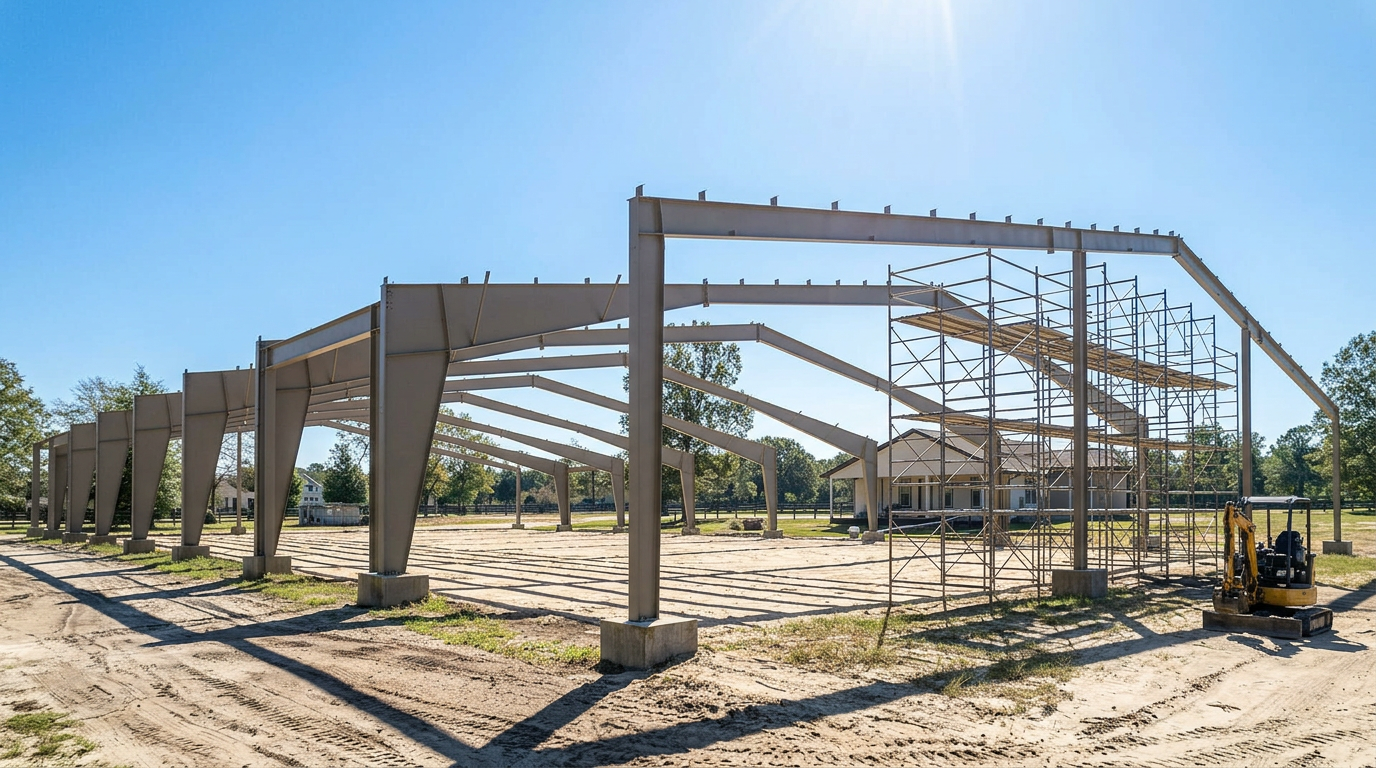
As of May 2026, the single biggest avoidable expense in metal building projects is not material cost or labor, it's rework triggered by design and planning mistakes made before the kit ever ships. Across the hundreds of projects MBMI has engineered nationwide, the pattern is consistent: most owners focus on square footage and price per foot, then discover halfway through assembly that they skipped a permit, poured the wrong foundation, or ordered a building that doesn't meet local snow-load requirements. The fix is always more expensive than getting it right the first time.
This guide walks through the most common design, planning, and installation errors we see in pre-engineered metal building (PEMB) projects, and the specific steps that prevent them. Whether you're planning an agricultural shop, a commercial warehouse, a barndominium, or an industrial facility, the same mistakes show up again and again. The good news: nearly all of them are caught and corrected during the engineering and permitting phase, if you know what to look for.
Building permits and local building codes must be obtained before construction begins. Failure to do so can result in legal penalties, stop-work orders, and the inability to occupy or insure the structure. Yet many owners schedule delivery before they've contacted the local building department, then find out their kit doesn't meet adopted wind-load or seismic requirements for their jurisdiction.
The International Code Council (ICC) publishes the International Building Code (IBC), which most U.S. jurisdictions adopt as the baseline for building design and construction. The IBC includes specific provisions for steel structures and metal buildings, covering design loads, material standards, and inspection requirements. Compliance with the adopted building code is mandatory before construction permits are issued.
In our experience running projects from Florida to the Pacific Northwest, the permit conversation should happen before you finalize your building size or roof pitch. Local building officials will tell you which code edition applies, what sealed drawings they need, and whether your site requires special foundation engineering or fire-rated assemblies. Waiting until the kit arrives to ask these questions turns a two-week permit review into a two-month redesign cycle.
What to do instead:

Inadequate or improperly designed foundations can lead to structural damage, settling, and potential collapse of metal buildings. A metal building kit needs a stable foundation to sit on. Skipping this step or using a subpar foundation can result in building shifts that lead to costly repairs down the line.
The American Society of Civil Engineers (ASCE) publishes ASCE 7 (Minimum Design Loads and Associated Criteria for Buildings and Other Structures), which requires geotechnical investigation and soil analysis before foundation design. Foundation design must be based on verified soil properties, including bearing capacity, settlement potential, and frost depth. Skipping soil testing is a common and costly mistake.
Larger structures may require soil tests to determine the stability of the ground. In addition, be sure to allow sufficient clearance around the foundation for delivery trucks and lift equipment. We've seen projects stall because the concrete truck couldn't access the pour site, or the crane couldn't swing panels over a fence line that wasn't marked on the site plan.
Most metal building anchoring relies on embed plates or anchor bolts cast into the concrete slab or pier footings. If those anchors are misaligned by even an inch, the first column won't plumb correctly, and every subsequent bay inherits the error. For detailed guidance on foundation types, soil-bearing requirements, and anchor-bolt layout, see our article on data-driven steel building foundation.
What to do instead:

Selecting an undersized metal building fails to account for current and future operational needs, resulting in inadequate workspace and costly expansion or replacement. It's important to accurately consider how much land you have to work with and how much room you'll need inside the building.
In the agricultural sector, we see this most often with equipment storage buildings. An owner measures their current tractor and planter, orders a 30×40 shop, then realizes six months later that they can't fit a grain cart or a combine head without leaving equipment outside. The same pattern shows up in commercial projects: a contractor orders a 40×50 warehouse based on today's inventory, then wins a larger contract and has to rent offsite storage because the building is full.
The fix, adding a lean-to or building a second structure, costs significantly more per square foot than ordering the right size up front. For reference, 40 x 60 offer roughly 2,400 square feet of clear-span workspace, which accommodates most small-fleet equipment storage or light manufacturing layouts. But if your operation is growing, a 50×80 or 60×100 building may pencil out better over five years than two smaller structures.
What to do instead:
The first mistake to avoid when constructing a metal building is choosing the wrong type of metal. It is important to consider the intended use of the building, the local climate and weather conditions, and the budget when choosing the type of metal to use.
Steel buildings in coastal zones face salt-air corrosion; buildings in the upper Midwest face heavy snow loads and freeze-thaw cycling; buildings in tornado-prone regions need higher wind-rated panels and fasteners. A standard 26-gauge Galvalume panel with R-10 faced insulation works fine in temperate zones, but the same assembly will condense heavily in an unheated agricultural building in Minnesota or fail prematurely in a marine environment without additional coatings.
For projects in snow-load zones, cold weather steel building design covers insulation strategies, vapor-barrier placement, and condensation control in detail. The short version: if you're in a climate with more than 30 pounds-per-square-foot ground snow load, your roof purlins, panel gauge, and insulation package all need to be engineered for that load, not just pulled from a standard kit catalog.
What to do instead:

Improper fastener installation, including over-tightening or under-tightening of screws, is a leading cause of water leaks in metal buildings. ASTM International publishes standards for fastener installation, including ASTM C1002 (Standard Specification for Steel Self-Drilling Tapping Screws). Proper fastener torque and installation technique are critical to structural integrity and weather-tightness.
Most metal building screws include long-lasting EPDM washers to prevent leaks. Ideally, the screw should be driven until the washer extends just beyond the screw head. In under-driven screws, the washer edges remain completely beneath the screw head, leaving a gap for water intrusion. Over-driving the screw squishes the washer too flat, compromising the seal and potentially dimpling the panel.
We've walked job sites where every roof panel had a mix of over-driven and under-driven fasteners, installed by a crew using impact drivers with no torque setting. The result: leaks at most the fastener locations within the first heavy rain. The fix, removing and replacing hundreds of screws, often with new panels, costs more than hiring an experienced crew in the first place.
What to do instead:
DIY metal building kits are precisely designed, engineered, and fabricated to meet specific loads. If something does not seem to fit as it should, refer again to the erection manual and plans. Never cut, weld, or tamper with the steel framing of DIY buildings.
The American Institute of Steel Construction (AISC) publishes AISC 360, the primary specification used by structural engineers in the United States for the design of steel buildings. AISC 360 establishes design criteria, material properties, and safety factors for structural steel. Non-compliance with AISC standards can result in structural inadequacy and failure to obtain building permits.
In our experience, the most common unauthorized modification is cutting a web opening in a roof purlin to run HVAC ductwork, or welding a mezzanine support to a mainframe column without consulting the engineer of record. Both actions void the structural certification and can trigger local building-official rejection during inspection.
For a detailed explanation of how girt and purlin bracing transfers lateral loads and why cutting or welding compromises that load path, see our article on modern bracing in metal buildings.
What to do instead:
You will need to know all your current local building codes before ordering your steel building. ASCE 7 (Minimum Design Loads and Associated Criteria for Buildings and Other Structures) is the primary standard used by structural engineers to determine design loads for buildings, including wind, snow, rain, and seismic loads. ASCE 7 provides maps and formulas for calculating loads based on location, terrain, and building characteristics. Incorrect load calculations or failure to account for local environmental conditions is a common design error that can lead to structural inadequacy.
A building engineered for 90-mph wind in central Texas will not meet code in coastal Florida, where design wind speeds can exceed 150 mph and the building official will require wind-borne debris impact-rated doors and panels. Similarly, a roof designed for 20 pounds per square foot snow load will sag or collapse under a 50-psf load in the Sierra Nevada.
What to do instead:
It can be tempting to try to save money by purchasing a metal building kit off the shelf from a big box store, but in almost every case, this decision ends up costing more in the long run. The most common mistakes people make when buying a metal building include scheduling delivery before obtaining building permits, pouring the foundation before receiving finalized building plans, and buying from a company without in-house engineering or detailing.
Big-box kits typically come with generic plans that are not sealed by a professional engineer and do not account for your site's specific wind, snow, or seismic loads. When you submit those plans to your local building department, they get rejected, and you're left paying a local engineer to redesign the building, often discovering that the kit you already bought won't meet code and can't be modified.
visit our site mean every project starts with a site-specific load analysis, sealed structural drawings, and a foundation plan that matches your soil conditions and local code. That engineering is included in the project cost, not tacked on as an afterthought when the permit gets denied.
What to do instead:
Our metal building kits come with detailed assembly instructions that should be followed carefully. Read the erection manual thoroughly. Follow its systematic instructions exactly. Give particular attention to the directions for bracing the framing of DIY metal buildings. Also, pay close attention to all the safety procedures in the manual.
The Occupational Safety and Health Administration (OSHA) publishes 29 CFR 1926 Subpart R (Steel Erection), which establishes mandatory safety requirements for structural steel assembly, including fall protection, personal protective equipment, and training requirements. Metal building erection is classified as steel erection work and must comply with these standards. Failure to follow OSHA requirements can result in citations, fines, and worker injuries.
Be sure everyone on the job site wears hardhats and the recommended safety gear. Strictly adhering to the manual's instructions protects both the building and the builders. We've seen crews skip the temporary bracing steps to save time, then watch the frame rack out of plumb when the first wind gust hits. The re-plumbing and re-squaring process takes longer than doing it right the first time.
What to do instead:
One of the biggest mistakes to avoid when constructing a metal building is improper installation. This can include issues such as incorrect placement of metal panels, failure to secure fasteners, and neglecting to properly seal seams and joints.
Panel installation errors show up as leaks, panel blow-off in high wind, and premature corrosion at unsealed laps. Most manufacturers specify a panel overlap of at least one corrugation at side laps, with fasteners placed in the flat of the panel (not the rib) at every purlin. Skipping fasteners or reversing the overlap direction (installing panels upwind instead of downwind) compromises weather-tightness.
Sealant placement matters. Butyl or silicone sealant tape should be applied to all side laps and endlaps before the next panel is installed. Applying sealant after the panels are up, trying to caulk gaps from the outside, does not work; water will find the path of least resistance and migrate under the panel.
What to do instead:
Not setting a realistic budget is one of the most common planning mistakes. Realistic budgeting for metal building projects must include design, materials, labor, permits, foundation, and contingency costs to avoid project delays and financial overruns.
Most owners budget for the building kit and the concrete slab, then discover they also need to pay for grading, utility trenching, electrical service upgrades, insulation, overhead doors, permits, and a crane for erection. A 60×80 commercial building kit might cost $45,000, but the total installed cost, including foundation, site work, doors, insulation, and electrical, often runs $90,000 to $110,000.
Financing options and payment terms should be evaluated and understood before ordering metal building kits to avoid cash flow problems and project delays. Many manufacturers offer in-house financing or can refer you to lenders who specialize in agricultural and commercial metal buildings. Getting pre-approved before you finalize your design prevents the scenario where you order a building you can't afford to finish.
For a detailed breakdown of what's included in a turnkey project and what you'll need to budget separately, data-driven metal building quote and ask for an itemized scope-of-work document.
What to do instead:
Choosing the wrong location can derail a project before it starts. Building location selection must account for site conditions, accessibility, utility availability, and zoning restrictions to avoid costly relocation or redesign.
We've seen owners pick a site based on aesthetics, "I want the building on the hill with a view", then discover the soil is all rock and ledge, requiring blasting and engineered piers that double the foundation cost. Or they choose a low-lying area that floods every spring, requiring fill and drainage work that wasn't in the original budget.
Zoning is the other common trap. Agricultural zoning typically allows barns, shops, and equipment storage without a variance, but if you're planning a commercial or residential use (like a barndominium), you may need a conditional-use permit or a zoning change. That process can take months and may be denied if neighbors object.
What to do instead:
Skipping detailed site evaluations or failing to develop clear project specifications can lead to costly delays and complications. Comprehensive site assessments are essential to understanding environmental and logistical factors.
A proper pre-construction site evaluation includes a survey to verify property boundaries and elevations, a geotechnical report for foundation design, a utility locate to mark buried lines, and a drainage plan to prevent water from ponding around the building. Skipping any of these steps increases the risk of mid-project surprises, discovering a buried septic tank under your proposed slab location, or finding out your site drains toward the building instead of away from it.
What to do instead:
Before you sign a contract and schedule delivery, verify the following:
If the answer to any of these questions is no, pause and address the gap before you order. The cost of getting it right up front is a fraction of the cost of fixing it later.
Metal building projects succeed when design, engineering, and planning happen before the first truck arrives. The mistakes outlined in this guide, skipping permits, undersizing the building, choosing the wrong manufacturer, ignoring load calculations, and cutting corners on the foundation, are all avoidable with a disciplined pre-construction process and the right engineering support. Take the time to plan, budget, and verify before you order, and you'll spend your construction phase assembling a building instead of fixing mistakes.
Ready to start your project with engineering and planning built in? metal building quote and get a custom quote based on your site, your loads, and your local code requirements.