
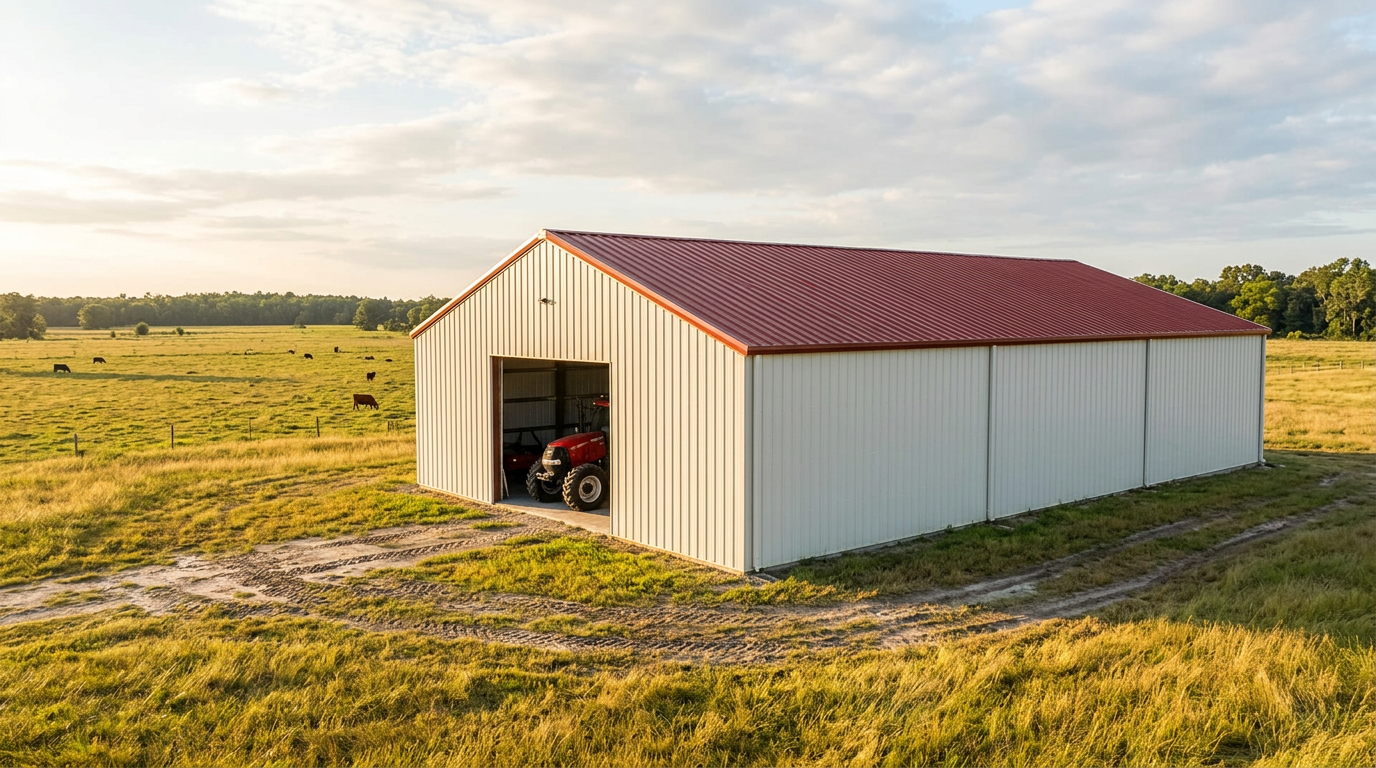
You can tell how long someone has been farming by how many times they have repaired a sagging barn door. Wood barns are beautiful in theory, right up until the moment you are replacing rotted sill plates in February because the moisture from last season's hay finally worked its way through the framing. Most agricultural operators eventually reach the same conclusion: if you want a building that stores equipment, protects grain, and shelters livestock without turning into a second full-time job, steel is the material that actually works.
Pre-engineered metal building systems have become the standard choice for new farm storage construction. The shift is not sentimental, it is economic. Steel buildings deliver longer service life, lower maintenance cost, and faster construction timelines than wood or pole-frame alternatives, and they do it at a price point that makes sense for working farms. In our years designing agricultural buildings across the country, the question we hear most often is not whether steel is the right choice, but how to spec the building correctly the first time so it handles the next thirty years without drama.
The Metal Building Manufacturers Association publishes technical bulletins and engineering reference materials governing pre-engineered metal building design, manufacturing, roof systems, energy performance, and accreditation standards for U.S. metal building manufacturers. Those standards exist because steel farm buildings are engineered structures, not field-assembled guesswork. Every component, from the primary framing to the roof panels, is designed to meet load tables, wind-speed maps, and snow-load requirements published in the International Building Code.
Wood barns rely on dimensional lumber that varies in strength, moisture content, and long-term stability. Steel framing uses material that meets ASTM International consensus standards covering steel grades, galvanizing, corrosion resistance, fastener performance, and material test methods. The result is a building where every beam, column, and connection is spec'd to a known capacity, not a best-guess allowance.
In practical terms, that means you can design a clear-span interior with no interior columns using engineered trusses or rigid frames. For equipment storage, that is the difference between maneuvering a combine around a forest of posts and driving straight in. For grain storage, it is the difference between stacking bags in narrow aisles and running a forklift anywhere you need it.
Steel also eliminates the ongoing maintenance cycle that defines wood barns. No rot, no termites, no annual paint jobs, no replacing siding every decade. Galvanized and painted steel panels hold up in wet climates, coastal salt air, and high-UV environments without the kind of degradation that turns a wood barn into a restoration project. The USDA Farm Service Agency offers farm loan programs and technical assistance for agricultural infrastructure projects, and in our experience, the operators who finance steel buildings spend less time managing the building and more time running the operation it was built to support.

Most farm storage buildings are asked to do three things at once: store equipment that is too expensive to leave outside, protect bulk materials that spoil if they get wet, and provide shelter for livestock during weather events. The limiting factor in a pole barn or wood-frame structure is almost always the interior column spacing. You can get a 40-foot clear span with heavy timber trusses, but anything wider requires intermediate posts, and those posts are exactly where you need to park the tractor.
Pre-engineered metal building systems use clear-span rigid frames or truss assemblies that eliminate interior columns entirely. The American Institute of Steel Construction publishes the Steel Construction Manual and AISC 360 Specification governing structural steel design, connections, load combinations, and engineering practice for steel-framed buildings. Those standards allow engineers to design open interiors that would be structurally impossible, or prohibitively expensive, in wood.
In our design conversations with agricultural clients, the most common request is maximum usable width with minimum obstructions. A 60-foot-wide clear-span building lets you park equipment side-by-side, stack hay bales in rows, and move livestock through wide aisles without bottlenecks. A 100-foot-wide clear span turns the building into a multi-use facility where you can store grain on one end, park machinery in the middle, and set up a calving pen on the other end, all under one roof, all accessible without navigating around columns.
The structural logic is straightforward: steel has a much higher strength-to-weight ratio than wood, so you can span longer distances with lighter members. Interior columns reduce usable floor space and create obstacles for equipment movement and material handling. In a steel building, that floor space remains available for storage, and you are not constantly repositioning equipment to work around obstructions.

Every farm storage building starts with the foundation, and the foundation starts with soil. The International Building Code establishes minimum design and construction standards for metal buildings, including agricultural structures, to ensure safety and structural integrity. Local building departments enforce the IBC and state-specific amendments, which means foundation requirements vary by jurisdiction and soil conditions.
In practical terms, that means you need a soil test before you pour anything. Soil bearing capacity determines whether you can use a simple concrete slab, a pier-and-beam system, or a more robust foundation with deeper footings. Local building codes specify minimum frost depths ranging from 0 to 48 inches depending on the region, and if you set footings above the frost line, the building will heave and settle every winter until something cracks.
Most agricultural metal buildings use one of three foundation types: a monolithic slab (concrete poured in one continuous pour with thickened edges), a pier-and-beam system (concrete piers supporting steel beams with a gravel or dirt floor), or a post-frame hybrid (steel building anchored to embedded wood or steel posts). The choice depends on budget, soil conditions, and how you plan to use the building. A grain storage facility benefits from a sealed concrete slab that keeps moisture out and makes cleanup easier. An equipment shed with frequent tractor traffic can get by with a compacted gravel floor and pier footings, saving cost without sacrificing structural integrity.
The steel building foundation article we maintain covers frost depth tables, bearing-capacity thresholds, and the difference between spread footings and continuous footings in detail. In our experience, the operators who skip the soil test and pour a slab on unstable fill end up with cracked floors and misaligned door tracks within two years. The operators who invest in proper site prep and engineered foundations get buildings that stay level for decades.

Agricultural buildings sit in open fields, which means they take the full brunt of wind and snow with no shelter from surrounding structures. The International Building Code establishes wind speed maps and snow load requirements based on geographic location, and those maps are not suggestions, they are the minimum design standard your building must meet to pass inspection.
Wind loads are expressed in miles per hour and mapped by county. A farm in coastal Texas might face 140-mph design wind speeds; a farm in central Kansas might see 115 mph. The difference determines how much steel goes into the framing, how the roof panels are fastened, and whether you need additional bracing in metal buildings to keep the building from racking under side loads.
Snow loads are expressed in pounds per square foot and vary by elevation and regional climate. A building in upstate New York might be designed for 50 psf ground snow load; a building in central Florida sees zero. The roof structure has to carry that load without deflecting, which means deeper trusses, closer purlin spacing, or heavier-gauge framing in high-snow regions.
In our design work, we see two common mistakes: underestimating wind loads because "we have never had a tornado here," and underestimating snow loads because "it usually melts off in a day or two." The building code does not care about historical averages, it cares about the worst-case event with a 50-year return interval. A building designed to 90-mph wind will fail in a 120-mph event, and the insurance adjuster will note that the structure was not built to code. A building designed to 20-psf snow load will collapse under a 40-psf wet-snow event, and the repair cost will exceed the original construction budget.
The good news is that pre-engineered metal building systems are designed to meet or exceed code-required loads as a baseline. The manufacturer runs the load calculations, the engineer stamps the drawings, and the building ships with a design that has already accounted for wind, snow, seismic, and dead loads. You still need to verify that the design matches your specific site conditions, but you are not starting from scratch.
Most farm storage buildings are used for more than inert equipment. Livestock need temperature regulation to stay healthy. Grain needs humidity control to avoid spoilage. Equipment benefits from reduced condensation to prevent rust. All of that depends on insulation and ventilation working together.
Metal building manufacturers offer insulation options including fiberglass batts, spray foam, and rigid foam systems. Proper insulation reduces heating and cooling costs and helps maintain optimal conditions for livestock and stored grain. The R-value you need depends on climate and use case. A heated livestock barn in Montana benefits from R-30 insulation in the roof and R-19 in the walls. An unheated equipment shed in Georgia can get by with R-10 or even uninsulated panels if condensation is not a concern.
Ventilation is the other half of the equation. Agricultural ventilation standards recommend air exchange rates based on building type and occupancy. Proper ventilation reduces respiratory disease in livestock and prevents grain spoilage from moisture accumulation. Ridge vents, gable vents, and powered exhaust fans all have a role depending on building size and use.
In our conversations with dairy and poultry operators, the most common complaint about older barns is poor air quality, ammonia buildup, dust accumulation, and humidity spikes that stress animals and degrade stored feed. A well-designed steel building with continuous ridge ventilation and sidewall louvers creates natural airflow that exhausts heat and moisture without relying on powered fans. Add insulation to moderate temperature swings, and you have a building that keeps livestock comfortable and grain dry without turning into an energy-cost nightmare.
You will use the doors on your farm storage building more than any other component. Equipment comes in and out multiple times a day. Livestock move through for feeding and sorting. Bulk materials get loaded and unloaded by forklift. If the doors do not work, the building does not work.
Metal building manufacturers offer customizable door options including 12- to 20-foot-wide sliding doors, 14- to 20-foot-wide roll-up doors, and bifold doors. Door selection depends on equipment size and operational requirements. A sliding door is simple, durable, and easy to repair, but it requires wall space on one side to slide open. A roll-up door takes up no floor space and opens vertically, but it requires headroom and regular maintenance on the springs and tracks. A bifold door splits in the middle and folds upward, offering full-width access with minimal side clearance.
In our experience, the operators who spec doors based on their largest piece of equipment, plus two feet of clearance on each side, end up with buildings that are easy to use. The operators who spec doors based on typical equipment and then buy a wider tractor three years later end up cutting new openings or maneuvering through tight clearances every time they park.
Walk doors and personnel access are the other consideration. A 60-by-120-foot building with only one overhead door means you walk the full length of the building to get in and out on foot. Adding a 3-by-7-foot walk door on the side wall saves steps and makes daily tasks faster. Adding a second walk door on the opposite end turns the building into a pass-through space where you can move tools, feed, and supplies without opening the main overhead door.
Steel farm buildings are functional first, but that does not mean they have to look like industrial boxes. Panel profiles, steel building colors, and trim details all affect how the building fits into the rural landscape and how well it holds up over time.
ASTM standards specify coating systems for metal buildings. Galvanized coatings provide corrosion resistance. Painted systems offer aesthetic options. Weathering steel develops a protective oxide layer over time. Most agricultural buildings use either Galvalume (aluminum-zinc alloy coating) or painted Galvalume panels. Choose finishes that match your climate and maintenance tolerance, and verify coating warranties before finalizing your order.
In our design work, we see a split between operators who want the building to disappear into the landscape (earth tones, low-profile roof, minimal trim) and operators who want the building to signal quality and investment (contrasting trim, standing-seam roof, architectural details). Both approaches work. The key is to choose finishes that match the climate and maintenance tolerance. A bright red barn in coastal salt air will fade and chalk faster than a tan or gray building. A dark roof in a hot climate will radiate more heat into the interior than a light-colored roof.
Standing seam roof panels cost more than exposed-fastener panels, but they eliminate the maintenance cycle of replacing worn washers and re-sealing fastener holes every decade. For a building you plan to own for thirty years, the upfront cost difference is minor compared to the long-term maintenance savings.
Most farm storage buildings fall into one of two categories: pre-engineered kits with standard dimensions and options, or fully custom designs engineered to specific site and use requirements. Metal building manufacturers offer standardized kit sizes that can be customized for different use cases. Popular sizes accommodate farm storage, equipment shelters, and livestock facilities.
A pre-engineered kit is faster to quote, faster to manufacture, and faster to erect because the design is already proven and the components are stocked. If your needs fit a standard 40-by-60, 60-by-80, or 80-by-100 footprint, a kit is the most cost-effective path. You still get to choose roof slope, door placement, insulation, and finishes, but the primary framing is a known quantity.
A custom design makes sense when your site has unusual constraints (odd-shaped lot, steep slope, proximity to property lines) or when your operational needs do not fit a standard box (L-shaped building, attached lean-to, integrated office space, overhead crane, mezzanine storage). Custom buildings take longer to engineer and cost more per square foot, but they deliver exactly what you need instead of forcing you to adapt your operation to a standard layout.
Pre-engineered metal agricultural buildings typically have shorter construction timelines, four to twelve weeks from order to occupancy, compared to traditional wood or concrete structures due to factory fabrication and standardized assembly. Metal building manufacturers produce components in controlled factory environments, reducing on-site construction time. Standardized designs and pre-drilled connections accelerate assembly. Shorter construction timelines reduce labor costs and project duration.
In our experience, the operators who invest time up front defining their requirements (clear-span width, door count and size, future expansion plans, electrical and plumbing rough-in) get buildings that serve them well for decades. The operators who rush the design phase and make decisions based solely on lowest quote end up with buildings that are too small, poorly configured, or missing critical features within a few years.
Not all metal building providers are the same. Some sell commodity kits with minimal engineering support. Some specialize in commercial or industrial projects and treat agricultural work as a side line. A few focus exclusively on farm and ranch buildings and understand the operational details that matter to working farms.
When evaluating providers, ask about in-house engineering capability. A provider with dedicated engineering staff can adapt standard designs to your site conditions, run custom load calculations, and stamp drawings for permit approval without outsourcing to a third-party engineer. That speeds up the process and ensures the design team understands your operational needs, not just the building code minimums.
Ask about material sourcing and manufacturing standards. Buildings that meet MBMA accreditation standards use steel that conforms to ASTM specifications, fasteners that meet ICC-ES approval, and coatings that carry manufacturer warranties. Buildings from unaccredited manufacturers may use thinner steel, lower-grade fasteners, or coatings that fail prematurely.
Ask about erection support. Some providers ship a kit and leave you to find a contractor. Others maintain networks of certified erectors who know the product and can complete the build on schedule. A few offer turnkey service that includes site prep, foundation, erection, and final inspection. The right model depends on your budget and your comfort managing subcontractors, but it is worth clarifying up front so you are not surprised when the kit arrives and you realize you still need to hire a crew.
Finally, ask about lead times and delivery logistics. Verify current lead times and delivery schedules directly with your provider, as manufacturing capacity and regional demand fluctuate. Realistic lead times and transparent communication are better indicators of a reliable partner than the lowest price.
The case for steel farm storage buildings is not complicated. Steel lasts longer than wood, requires less maintenance than pole barns, and costs less over a thirty-year lifespan than any alternative. It is not the romantic choice, wood barns photograph better and fit the pastoral aesthetic, but it is the choice that lets you focus on farming instead of building maintenance.
In our years working with agricultural clients nationwide, the pattern is consistent: operators who build steel once rarely go back to wood. The buildings do what they are supposed to do, year after year, without drama. Equipment stays dry. Grain stays sound. Livestock stay comfortable. And when a storm rolls through, the building is still standing when the cleanup starts.
If you are evaluating options for new farm storage, the questions worth asking are not whether steel is the right material, it is, but how to spec the building correctly for your operation. Clear-span width, door placement, insulation strategy, and foundation design all matter more than the sticker price on the quote. A building designed to your actual needs, engineered to code, and built to last will serve your operation for decades and cost less per year than the wood barn you keep repairing.
For a closer look at how agricultural steel buildings perform in real-world conditions, the custom barndominium in Blue Ridge, Georgia case study shows a finished custom build in a rural setting, complete with client feedback and long-term performance notes. If you want to understand the metal building terminology before you start the design conversation, we maintain a glossary that covers clear-span, purlin, girt, eave height, and the other terms you will see on quotes and drawings.
Ready to spec a farm storage building that fits your operation? Request a price quote today and work directly with our in-house engineering team to design a steel building that handles your equipment, protects your assets, and lasts for decades without turning into a maintenance project. We serve agricultural clients nationwide from our Delray Beach, Florida headquarters, and every building is custom-designed to your site conditions and operational requirements.