
TL;DR: Steel building quotes only mean something when they cover the same scope, engineering, and service, not just the headline price. Here’s how to compare MBMI, General Steel, and Rhino apples-to-apples and spot the gaps that make a cheap quote expensive.
When you gather quotes for a commercial steel building, the hardest part isn’t getting numbers, it’s comparing them fairly. Two quotes that look similar can represent very different scopes, engineering, and levels of service, and on a large project those differences drive your real total cost far more than the headline figure. This guide lays out how to compare steel building companies on what actually matters, and gives a fair, factual look at three well-known names buyers often weigh: MBMI, General Steel, and Rhino Steel Building Systems.
We don’t publish prices, and you should be cautious of anyone who makes a firm price feel too easy. Steel costs move constantly and a real, engineered price depends on your size, location, loads, and finishes. The goal here is to help you compare quotes intelligently, not to rank companies by a number.
Before looking at any company, get clear on the criteria that separate a good deal from an expensive mistake:
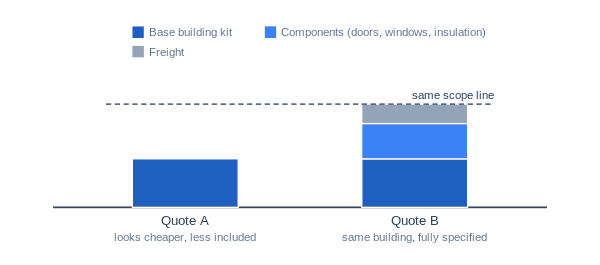
1. Scope: are you comparing the same thing? One quote may be a bare steel kit; another may include more components, freight, or services. Normalize every quote to the same scope before comparing. This single step resolves most “why is this one cheaper?” confusion.
2. Engineering depth. Who engineers the building, and to what loads? A building engineered in-house to your exact ZIP-code wind, snow, and seismic loads is a fundamentally safer purchase than a generic design. On a large project this is the difference between passing inspection cleanly and facing costly redesigns.
3. Fabrication quality. Is the steel fabricated to a recognized standard (such as IAS or AISC accreditation)? Fabrication quality affects fit, durability, and how smoothly erection goes.
4. Warranty. Compare structural and paint/coating warranties carefully; they vary widely between companies and signal a company’s confidence. Weigh them alongside engineering, because a building designed to perform in the first place rarely needs a warranty to fall back on.
5. Service model. Do you get a real person who helps with specs, permitting, and problem-solving, or a self-service transaction? On a complex commercial build, service has real dollar value.
6. Track record on projects like yours. Has the company delivered buildings at your size and use? Large commercial projects reward proven experience.
Each of these companies has real strengths and serves real customers well. Here’s a factual look at how they position themselves.
General Steel is one of the most recognized names in the industry. On its own site, the company says its building system can be clear-span up to 300 feet, offers three framing lines (premium I-beam, C-channel, and an economy tube option), and publishes strong product warranties, including a 50-year structural warranty on I-beam framing and a 40-year paint warranty. It is known for a fast, streamlined online quoting process (an online price tool and a 3D building designer) and includes a project coordinator at no additional cost. If brand recognition and a quick online quote rank high for you, General Steel is a natural company to include in your comparison.
Rhino Steel Building Systems, based in Denton, Texas, fabricates red-iron steel framing and is best known for its Lifetime Structural Warranty on that framing, which the company notes is longer than the 20-to-30-year structural warranties most manufacturers offer. Rhino pairs that with a 30-year SMP paint warranty and a 25-year Galvalume coating warranty. For buyers who weigh a long structural warranty heavily, Rhino’s coverage is a genuine differentiator worth evaluating.
MBMI, based in Delray Beach, Florida and building steel, competes on the factors that actually decide whether a large commercial project comes in on time and on budget: engineering depth and execution. Every MBMI building is engineered in-house to your exact ZIP-code wind, snow, and seismic loads, and fabricated in an IAS-certified facility built to MBMA standards. It carries a 40-year paint warranty, ships nationwide, and comes with live-person support through specs, permitting, and erection rather than a self-service checkout.
The proof is in the client roster. MBMI has delivered buildings for NASA, Ford, Cemex, BP, and Firestone, organizations that award work on engineering and reliability, not on the lowest sticker price. That track record is the strongest signal MBMI can deliver a large or complex commercial, industrial, or agricultural project right the first time.
There’s no single best. The right choice depends on what you value:
Many serious buyers get quotes from more than one of these, which is exactly the right approach, as long as you compare them on the criteria above and not on the headline number alone.
A long structural warranty sounds reassuring, but its real value is in the fine print, not the headline number. Before you weigh a “50-year” or “lifetime” structural warranty heavily, ask the company for a copy of the actual written warranty and read it closely: what exactly is covered, for how long, what the underlying steel is warranted for by the mill, and which conditions or exclusions apply. A warranty is only as strong as the terms behind it and the company standing behind those terms, so compare the documents, not just the advertised years.
The practical takeaway: ask every company you are comparing for a copy of its written warranty, read what it actually guarantees, and weigh it against the engineering and fabrication behind the building, because that is what decides whether you ever need to rely on it. It is one reason MBMI competes on engineering first rather than on a headline warranty number.
Here’s the reasoning behind MBMI’s positioning, and it’s worth understanding regardless of who you choose. On a small building, price differences are small and low-stakes. On a large commercial building, the steel kit is only part of your total cost. The expensive risks are failed inspections, redesigns because drawings weren’t engineered to your actual loads, rework when parts don’t fit, and delays that push back the day the facility earns revenue. Any one of these can cost more than the difference between the cheapest and the most-engineered quote.
That’s why, at scale, engineering quality and a proven track record tend to matter more than the lowest bid. It’s not a knock on fast, economical options. For the right project, they’re a great fit. It’s an argument that as your building gets larger and more complex, the criteria that protect your total cost shift from price toward engineering and execution.
→ Get your exact, current MBMI price with the Price Calculator
Who makes the best commercial steel buildings? There’s no single best. It depends on your project and priorities. General Steel is strong on brand and fast quoting for large clear-spans; Rhino stands out on lifetime structural warranty; MBMI leads on in-house engineering, buildings engineered to your loads, and service for large or complex projects. Compare on scope, engineering, warranty, and service, not price alone.
Why are some steel building quotes so much cheaper? Usually because they cover a narrower scope or a different engineering standard. Normalize every quote to the same scope and loads before comparing; a low number often means less is included or the steel is engineered to lighter assumptions.
Does MBMI publish prices? No, steel costs change constantly and a real price depends on your specs and location, so MBMI prices every building live. Use the Price Calculator for a current, engineered number.
What should I weigh most on a large project? Engineering depth, fabrication quality, and track record: these protect your total cost far more than a small difference in sticker price once inspections, rework, and schedule are counted.
Is a longer structural warranty always better? Not necessarily. A warranty’s value is in its actual terms and who backs them, not the number of years advertised. Ask any company for its written structural warranty and read what is covered, for how long the underlying steel is warranted, and what exclusions apply, then weigh it alongside the engineering and fabrication standard behind the building.
Can I get quotes from multiple companies? Absolutely, and you should. Just compare them on the same scope and on the criteria that matter, not on the headline figure.
Get a current, engineered MBMI price built to your project, and compare it on total value:
→ Use the Price Calculator or call 1-800-293-2097 to speak with an MBMI building specialist.
Details about other companies come from each company’s own website: