
TL;DR: A steel building kit gives you the lowest cost and the most control if you can manage the build; a design-build contractor costs more but delivers it turnkey. Here’s how the two compare on total cost of ownership, and how to tell which fits your team.
When you build a commercial steel building, one of the first big decisions is how to buy it: do you purchase an engineered steel building kit and manage the foundation and erection yourself (or through your own subs), or do you hire a design-build contractor to deliver the whole project turnkey? The right answer depends on your experience, your capacity to manage a project, and how you weigh cost against convenience and risk. This guide compares the two paths on total cost of ownership (the number that actually matters), not just the up-front price.
As always, you won’t find dollar figures here. Costs move with the steel market and depend entirely on your building, site, and location. What we can do is lay out where the real costs and risks live in each path, so you can make an informed choice, and get a live, engineered price for the building itself.
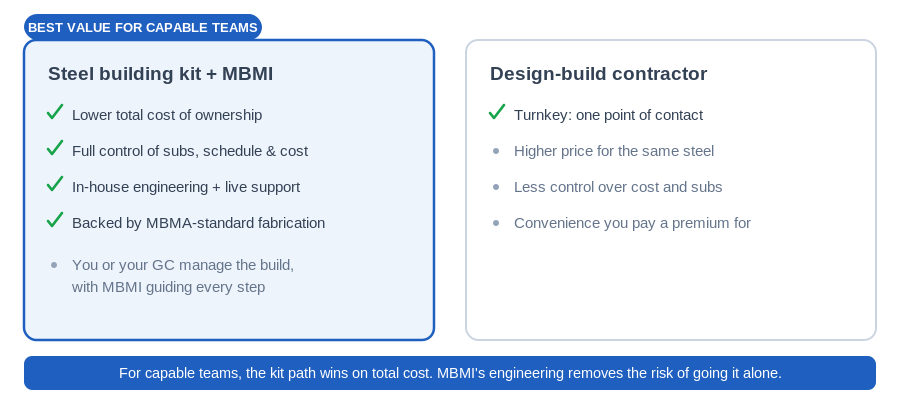
Steel building kit. You buy the engineered building (primary and secondary framing, cladding, fasteners, and engineered drawings) from a manufacturer. Then you, or contractors you hire, handle the foundation, erection, permits, and site work. You act as your own general contractor, or hire one separately. This path gives you the most control and typically the lowest cost for the building itself, in exchange for taking on project management.
Design-build contractor. You hire one firm to design, engineer, supply, and construct the finished building: a single point of responsibility from drawing to keys. You trade some control and some cost for convenience, coordination, and reduced management burden.
However, these are not fully either/or. A strong kit manufacturer supports you well through the process (engineered drawings, erection guidance, and specialist help), which narrows the gap between “just a kit” and a fully managed project.
The mistake buyers make is comparing the kit price to the design-build price as if they’re the same purchase. They’re not. Total cost of ownership includes several layers beyond the building:
The building (kit). The engineered steel package, comparable in both paths, since a design-builder also buys or fabricates the steel.
Foundation and site work. Required either way. In the kit path you procure it; in design-build it’s bundled.
Erection labor. In the kit path you hire an erector or crew; in design-build it’s included and coordinated.
Project management and coordination. In the kit path, this is your time (or your GC’s fee). In design-build, it’s built into the contractor’s price. This is the layer buyers most often undervalue, because managing a build is real work and real risk.
Permits, engineering, and compliance. Engineered drawings come with a quality kit; you or the contractor manages the rest of the permit and inspection process.
Risk and rework. The hidden cost. Mistakes in coordination, an under-engineered building, or a foundation that doesn’t match the steel create expensive rework. Splitting responsibility raises this risk, while managing it well lowers it, whether that is you, a good GC, or a competent design-builder.
When you add these up, the kit path usually has a lower total cost if you have the experience and capacity to manage the project well. Design-build usually has a higher price but lower management burden and consolidated responsibility. In short, neither is cheaper in the abstract; it depends on what your time and risk are worth.
→ Get an exact, current price for the building itself
A steel building kit is usually the better value if:
Experienced commercial builders, developers, contractors, and many business owners with capable teams choose the kit path for exactly these reasons, and lean on the manufacturer’s engineering and support to de-risk it.
A design-build contractor is usually better if:
Whichever path you choose, the engineering behind the building is what protects your total cost of ownership. A building engineered in-house to your exact ZIP-code loads and fabricated to a certified standard is a lower-risk asset: it passes inspection cleanly, the parts fit, and it stands up to the conditions it faces. Under-engineered steel is the most expensive thing you can buy, because the rework, delays, and failures land in the “total cost” column you don’t see on the quote.
This is why MBMI supports the kit path so strongly: buyers get a building they can trust (engineered to their loads, fabricated at an IAS-certified facility built to MBMA standards, backed by a 40-year paint warranty) plus live-person help through specs, permitting, and erection. You get the control and cost advantage of the kit path without carrying the engineering risk alone.
MBMI delivers pre-engineered steel buildings nationwide with an in-house engineering team, buildings engineered to your exact ZIP-code loads, IAS-certified fabrication built to MBMA standards, and a 40-year paint warranty, for clients including NASA, Ford, Cemex, BP, and Firestone. Whether you’re managing the project yourself or coordinating with a contractor, MBMI gives you a building engineered to be built right, and the live-person support to keep your project on track. On a large commercial project, that’s what keeps total cost of ownership low.
Is a steel building kit cheaper than hiring a design-build contractor? For the building itself, usually yes, but total cost of ownership depends on who manages the foundation, erection, and coordination. If you can manage the project well, the kit path is typically lower total cost; design-build costs more but reduces your management burden and consolidates responsibility.
Do I have to be a builder to buy a steel building kit? No, but you (or a GC you hire) need to manage the foundation, erection, and permits. A quality manufacturer supports you with engineered drawings, erection guidance, and specialist help, which makes the kit path accessible to many business owners.
What’s included in a steel building kit? Typically the engineered primary and secondary framing, roof and wall panels, fasteners, trim, and engineered drawings. Foundation, erection, and site work are separate.
What drives total cost of ownership beyond the kit price? Foundation and site work, erection labor, project management, permits, and (the big hidden one) the risk of rework from poor coordination or under-engineered steel. Good engineering lowers that risk.
Does MBMI sell kits, manage projects, or both? MBMI provides engineered building kits with detailed engineered drawings and strong live-person support through specs, permitting, and erection, giving you the control and cost advantage of the kit path with the engineering handled.
Get a current, engineered price for the building, then choose the path that fits your team:
→ Use the Price Calculator or call 1-800-293-2097 to speak with an MBMI building specialist.