

TL;DR: Most commercial steel buildings are 39-year property, but farm buildings, factory floor space and some upgrades can be written off much faster.
Bonus depreciation is a federal tax rule that lets a business deduct the full cost of qualifying property in the year it’s placed in service, instead of spreading the deduction over many years. A 2025 tax law made the 100 percent rate permanent for property acquired after January 19, 2025. The catch for steel building buyers is that most buildings don’t qualify.
A commercial building is depreciated over 39 years, and bonus depreciation only covers property with a recovery period of 20 years or less. There are some real exceptions, though, and they’re worth knowing before you set your project timeline.
We design and manufacture steel buildings; we don’t prepare tax returns. Use this as background for a conversation with your CPA, who can tell you how the rules apply to your business and your numbers.
The IRS treats a typical office, warehouse, retail building or shop as nonresidential real property. That category is depreciated on a straight line over 39 years. On a $600,000 building, that works out to roughly $15,400 a year, with a smaller amount in the first year because of how the IRS counts partial months.
Bonus depreciation was written for shorter-lived property such as equipment, vehicles and certain improvements. Since the building itself sits well outside the 20-year cutoff, the 100 percent deduction you may have heard about doesn’t apply to the shell of a general commercial building.
That doesn’t mean the tax picture is the same for every steel building. Three things change it: what the building is used for, what goes inside it, and whether you’re building new or improving a building you already own.
Agriculture gets different treatment. In the IRS Farmer’s Tax Guide, general-purpose farm buildings are listed as 20-year property. That puts them inside the bonus depreciation cutoff, so a barn, equipment shed or hay storage building used in a farming business can qualify for the 100 percent first-year deduction.
Picture a cattle operation that adds a 60 by 120 equipment and hay building. If that building qualifies as a farm building, the owner may be able to deduct its full cost in the year it’s placed in service rather than over 20 years. For a lot of farms, that’s the difference between a building that pencils out this year and one that waits.
The IRS also recognizes single-purpose agricultural or horticultural structures. These are buildings designed and used only for a specific job, such as housing and feeding a certain type of livestock or growing plants commercially in a greenhouse. They qualify for the Section 179 expense deduction, which general farm buildings don’t.
The word “only” matters here. A livestock building that also stores boats or serves as a general workshop can lose its single-purpose status. If you’re planning farm steel buildings for a specific livestock or growing use, tell your CPA early so the design and the way you plan to use the building line up with how you intend to depreciate it.
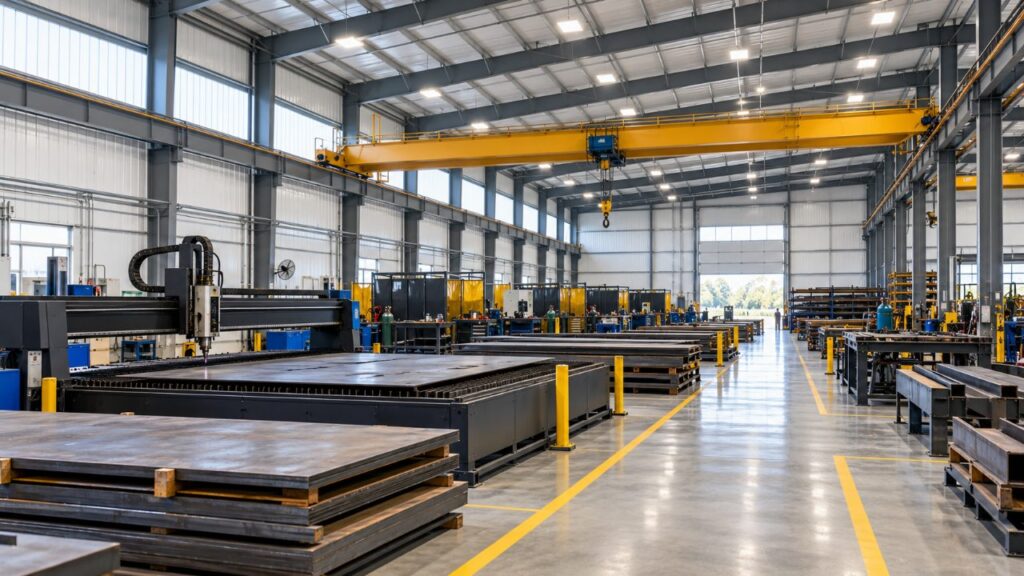
The same 2025 law created a new deduction aimed at factories. Treasury and the IRS describe qualified production property as nonresidential real property used as an integral part of a manufacturing, chemical production, agricultural production or refining activity. Businesses can elect to deduct up to 100 percent of the cost of that property, as explained in the IRS announcement of the qualified production property guidance.
This is a big change for anyone building a plant. Until now, a manufacturing building was treated like any other commercial building and written off over 39 years.
The rule comes with timing and use requirements. Under the law and the IRS notice issued in February 2026:
The deduction applies to the part of the building where production actually happens. Offices, sales areas, parking and finished-goods storage generally don’t qualify. If 95 percent or more of the building is used for the qualifying activity, the whole building can be treated as qualified.
Say you’re planning a 120 by 200 fabrication plant with a 4,000-square-foot office and a 6,000-square-foot area for finished goods waiting to ship. The office and the shipping storage would likely stay on the 39-year schedule, while the production floor could be eligible for the 100 percent deduction. When we draw up a plant at MBMI Metal Buildings, the floor plan and engineered drawings show each area of the building, which helps your CPA document which space is production and which isn’t. It pays to lay out the building with clearly separated uses.
Section 179 is a separate rule that lets businesses expense certain property up front. The 2025 law raised the limit to $2.5 million, with the deduction phasing out once a business places more than $4 million of qualifying property in service in a year. Both amounts are indexed for inflation starting in 2026.
For buildings, Section 179 mainly helps with improvements to an existing nonresidential building. The IRS calls these qualified real property, and they include:
So if you own an older commercial building and replace its roof or HVAC system, that work may be deductible up front instead of depreciated over decades. It doesn’t apply to the original construction of a new building.
Section 179 has a limit that bonus depreciation doesn’t. The Section 179 deduction can’t be more than your taxable income from active business activity for the year, though any unused amount can carry forward. Bonus depreciation has no income limit. Your CPA will usually decide which tool to use for each item based on your income that year.
A lot of the money in a commercial project goes into things that aren’t the building at all. Shop equipment, pallet racking, vehicle lifts, process machinery and similar items are generally equipment with much shorter recovery periods, so they can often qualify for bonus depreciation even when the building doesn’t.
Some items blur the line. A bridge crane, for example, may have parts that are equipment and parts that are tied into the building’s structure. On larger projects, owners often pay for a cost segregation study, where a specialist goes through the project and sorts each cost into the right category. On a building with a lot of equipment and site work, that study can move a meaningful share of the cost into faster depreciation.

This is where a lot of year-end plans fall apart. The deduction depends on when property is placed in service, which means ready and available for its intended use. It doesn’t depend on when you sign the contract, pay a deposit or take delivery of the steel.
A building ordered in November is very unlikely to be designed, manufactured, delivered, set on a finished foundation and erected by December 31. If you’re hoping to take a deduction this year, it usually has to be for a project that’s already close to done. A certificate of occupancy or final inspection can help show the building was ready to use before year-end.
For most buyers, the better move is to plan the next tax year. If you want a building in service by a certain date, work backward from it. Engineering, approval drawings, permitting, manufacturing, foundation work and erection all take time, and each step depends on the one before it.
That’s why it helps to request a steel building quote well before your target date. Once you have a price, drawings and a realistic delivery window, your CPA can plan the deduction around real dates instead of hopes.
You’ll get a more useful answer if you walk in with the details your CPA needs:
When you’re ready to price the building itself, ask us for a quote and drawings that show the layout clearly. That makes it easier for your tax advisor to separate production space from office and storage space, and to match the deduction to the right part of the project.
Usually not on a general commercial building. Offices, warehouses, shops and retail buildings are 39-year property, and bonus depreciation only covers property with a recovery period of 20 years or less. Farm buildings and qualifying manufacturing space are the main exceptions, and equipment inside the building often qualifies on its own.
It can. The IRS lists general-purpose farm buildings as 20-year property, which falls inside the bonus depreciation limit. The barn has to be used in a farming business, so a barn on a hobby property or used for personal storage won’t qualify. Your CPA can confirm how your operation is classified.
It’s nonresidential real property used as an integral part of manufacturing, chemical production, agricultural production or refining. Construction has to begin after January 19, 2025, and before 2029, and the property has to be placed in service before 2031. Only the production space counts, so offices, sales areas and finished-goods storage are generally left out.
No. The deduction depends on when the building is placed in service, meaning ready and available for its intended use. Paying a deposit or taking delivery of the steel in December doesn’t count if the building isn’t finished and usable by December 31.
Not for the original construction of a typical commercial building. Section 179 does cover certain improvements to an existing nonresidential building, such as a new roof, HVAC, fire protection and security systems. Single-purpose agricultural and horticultural structures also qualify for Section 179.