Tag: agricultural metal buildings

  • Fire Safety in Steel Buildings: Protection and Insurance Benefits

    Fire Safety in Steel Buildings: Protection and Insurance Benefits

    The insurance quote came back 40% lower than the wood-framed building next door. Same size, same use, different material. When the business owner called to confirm the numbers, his agent had a simple explanation: “Steel doesn’t burn. Your premiums reflect that.”

    Fire safety discussions often focus on sprinkler systems, exit signs, and alarm codes. Those matter, but the biggest fire safety decision happens much earlier, when you choose what to build with. Steel’s fire resistance isn’t an upgrade or add-on. It’s fundamental to the material itself, and it affects everything from occupant safety to insurance costs to long-term liability.

    The Material Advantage

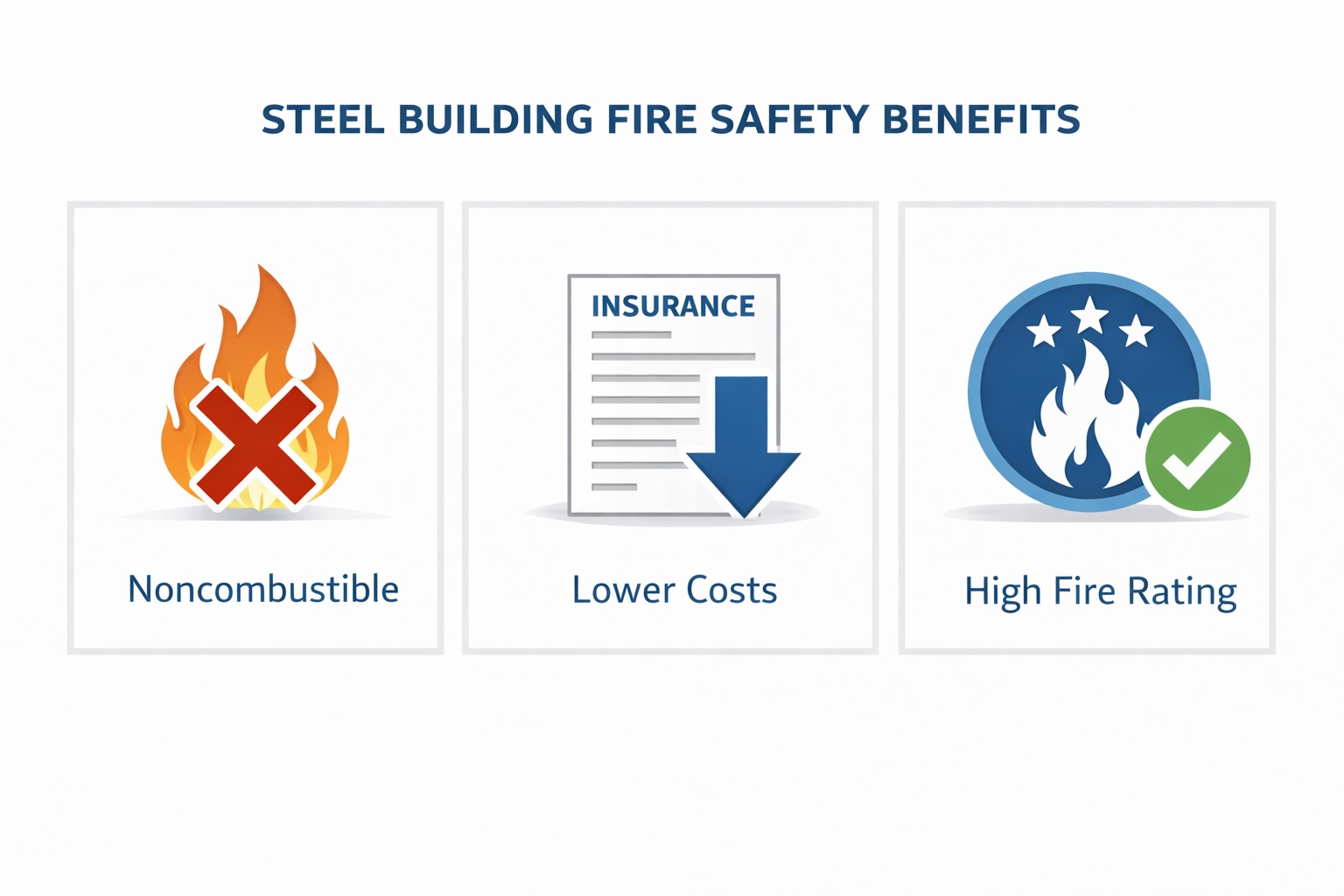
    Steel is noncombustible, which means something specific and important: it doesn’t ignite, doesn’t contribute fuel to fires, and doesn’t release toxic smoke when exposed to flames. Wood construction presents the opposite profile. Lumber ranks as the number one source of first-ignited material in building fires, and wood framing actively fuels fires once they start, accelerating spread and increasing danger.

    The difference matters most during the critical early minutes of a fire. While steel eventually weakens at extreme temperatures (typically above 1,000°F), it maintains structural integrity far longer than the time needed for occupants to evacuate safely and for firefighters to begin controlling the blaze. Wood structures contribute massive fuel loads that make fires harder to control and more dangerous to fight. Steel adds zero fuel, giving emergency responders a fundamentally different situation to manage.

    This fire performance advantage is built into the material itself. There are no special treatments to maintain, no coatings to reapply, no inspection schedules to track. The steel framing that gives you clear-span space and design flexibility also provides fire resistance that never degrades over the building’s life.

    Insurance Economics

    Lower insurance premiums on steel buildings aren’t theoretical savings; they’re standard practice. Commercial property insurance rates directly reflect fire risk, and steel buildings typically see 15-30% lower premiums compared to similar wood-framed structures. For a building insured at $500,000, that translates to $3,000-$8,000 saved annually, year after year.

    The savings compound impressively over time. Across a 30-year building life, lower insurance premiums can total $90,000-$240,000. That often covers the entire cost difference between steel and wood construction, making steel effectively free from an operating cost perspective. Beyond the premium savings, insurers offer broader coverage and higher limits on steel buildings due to reduced fire risk, giving you better protection at lower cost.

    These aren’t projections or estimates, but actual premium differences you can verify before building. Ask your insurance agent for quotes on both materials during project planning. The premium difference often surprises business owners who assumed steel was simply more expensive without considering decades of operating cost advantages.

    Building Code Requirements

    Building codes specify fire ratings based on how buildings are used, how many people occupy them, and how close they sit to property lines. Fire resistance ratings measure how long building elements can resist fire exposure, with common requirements including 1-hour, 2-hour, and 3-hour resistance depending on the specific application. Steel buildings meet these requirements through proper design and fire-resistant assemblies.

    Fire-rated assemblies might include gypsum board over steel framing, spray-on fireproofing that insulates structural members, or intumescent coatings that expand when heated to protect the steel beneath. The specific approach depends on your building’s code requirements, but steel framing accommodates all these protection methods readily. In many cases, sprinkler systems reduce or eliminate fire rating requirements entirely, making code compliance simpler and more cost-effective.

    Working with your building designer and local building department during early planning ensures you understand specific requirements for your application. Understanding established fire safety standards for commercial buildings helps you meet all requirements without overbuilding or paying for unnecessary protection levels.

    Wildfire Considerations

    Western states face increasing wildfire risk, with California, Colorado, and other regions implementing stricter building standards for fire-prone areas. Steel buildings provide critical advantages where wildfire threatens structures. The noncombustible exterior means steel panels don’t ignite from wind-blown embers, which is the primary way wildfires spread to buildings. Wood siding catches fire from these embers; steel doesn’t, giving structures meaningful protection during wildfire events.

    Metal roofing achieves Class A fire ratings, the highest classification available, meaning embers landing on steel roofs won’t start fires. This protection matters enormously in wildfire country, where wind-driven embers can travel miles ahead of the main fire front. When combined with defensible space around the structure, noncombustible construction creates a genuinely fire-resistant building that can survive conditions that would destroy wood structures.

    Many high-risk states now offer incentives and expedited permitting for fire-resistant construction. These programs recognize that noncombustible buildings reduce overall community fire risk and emergency response burdens. Check local programs during planning, as the combination of lower insurance costs, permitting advantages, and actual fire protection often makes steel the clear choice in fire-prone regions.

    Practical Safety Features

    Beyond material advantages, thoughtful design improves fire safety outcomes. Compartmentalization uses fire-rated walls and doors to separate spaces, containing fires to specific areas and preventing spread throughout the facility. This approach gives occupants in other areas more time to evacuate and gives firefighters more options for controlling the blaze before it becomes catastrophic.

    Proper exit planning ensures people can evacuate quickly when emergencies occur. Code-compliant exits, clear signage, unobstructed egress paths, and adequate exit capacity for your building’s occupant load all contribute to safety during fires and other emergencies. Steel buildings accommodate these requirements easily, with clear-span construction avoiding the interior obstacles that can complicate emergency egress in other building types.

    Fire suppression systems including sprinklers, extinguishers, and alarm systems integrate readily into steel building design. The noncombustible construction actually makes these systems more effective since they’re protecting against fire spread rather than also fighting the building itself as a fuel source. Quality electrical installations prevent fires from starting in the first place, since many building fires originate from electrical faults, making proper installation and code-compliant systems important prevention measures.

    Common Questions

    Do steel buildings need fireproofing? It depends on building codes and specific fire rating requirements for your application. Many steel buildings don’t need additional fireproofing because the noncombustible construction meets code requirements without it. Buildings requiring specific fire ratings use spray-on fireproofing, intumescent paint, or gypsum board assemblies to achieve those ratings. Your building designer determines requirements during the planning phase based on building use and local codes.

    How much do insurance savings offset steel building costs? Insurance savings of $3,000-$8,000 annually compound quickly. Over 20-30 years, lower premiums often equal or exceed any cost premium paid for steel over wood construction. The payback period typically runs 5-10 years, after which the savings continue for the building’s entire life. These aren’t optimistic projections, but actual premium differences you can verify with insurance quotes during project planning.

    Are steel buildings safer in warehouse fires? Significantly safer. Warehouses storing combustible materials face inherently high fire risk, making the building’s fire performance crucial. Steel framing that doesn’t contribute fuel to fires provides protection that often means the difference between a contained fire and total loss. Many warehouse fires that completely destroy wood buildings leave steel structures damaged but repairable, preserving the business’s ability to recover quickly.

    Does steel rust after fire exposure? Fire-damaged steel can rust if protective coatings burn off during the fire. However, this represents a repair issue rather than structural failure. The steel itself remains intact and can be cleaned, treated, and recoated to restore protection. Wood structures exposed to the same fire conditions burn completely, so there’s nothing left to repair, only total replacement costs.

    Build Safer, Save Money

    Fire safety in steel buildings doesn’t require special features, expensive upgrades, or ongoing maintenance programs. The fire resistance is inherent to the material, providing protection from day one through the building’s entire service life. That built-in safety advantage translates directly to lower insurance premiums, reduced liability exposure, and better protection for people and property.

    Ready to discuss your building project? Contact us today to explore steel building systems that deliver superior fire safety alongside lower operating costs. Our team helps you understand how material choice affects both immediate safety and decades of financial performance.

    We build with fire safety built in.

  • Steel Building Expansion: When and How to Add On

    Steel Building Expansion: When and How to Add On

    The “FULL” sign went up on the warehouse door for the third time this month. Not the bathroom. The actual warehouse.

    Five years ago, this 80×100 building felt enormous. Now? Inventory stacks higher than safety guidelines recommend. The forklift driver navigates paths that get narrower every quarter. You’re considering renting off-site storage, which feels ridiculous when you’re standing in a building you own.

    Here’s the thing about successful businesses: they outgrow their spaces. It’s a good problem, but it’s still a problem. The question isn’t whether you need more room. The question is whether you expand what you have or start fresh somewhere else.

    Steel buildings make expansion surprisingly straightforward. Unlike traditional construction where adding on means complex structural modifications, steel buildings essentially snap together like industrial Lego. The same engineering principles that created your original building work for additions. Understanding your options helps you grow smartly without overspending or overbuilding.

    The Right Time to Expand

    You don’t need a consultant to tell you when space becomes a real problem. Your daily operations make it obvious.

    You’re refusing profitable work because you physically can’t fit more inventory or production equipment. That’s revenue walking out the door to pay for space you haven’t built yet.

    Safety margins are disappearing. Aisles that used to accommodate two-way forklift traffic now require careful choreography. Exit paths have obstacles. Equipment clearances make you nervous during inspections.

    Operational efficiency tanks. Workers spend more time moving things around to access other things. Simple tasks take longer because everything’s in someone’s way.

    When these problems persist for months rather than weeks, expansion makes more sense than reorganizing what you have for the fourth time.

    Your Expansion Options Explained Simply

    Steel buildings expand three ways. Each works better for different situations.

    Make It Longer (End Wall Expansion)

    The most common approach: remove one end wall and add more building in the same direction. Think of it like adding train cars to a locomotive.

    This works because steel buildings use identical frame sections repeated however many times you need. Your 80-foot building is really four 20-foot sections. Adding another 40 feet just means adding two more identical sections.

    The catch: You need available property behind your building, and you’ll close that end temporarily during construction (usually 1-2 weeks for the actual connection).

    Best for: Properties with room to extend, businesses that can work from one end while the other end is under construction.

    Make It Wider (Side Wall Addition)

    Instead of going longer, go wider. This requires more engineering because you’re changing the roof structure rather than just extending it, but it works well on narrow properties with side yard space.

    The catch: More complex engineering means higher costs per square foot and longer planning time.

    Best for: Properties with limited frontage but good side yard access, operations that need the addition parallel to current workflow rather than extending it.

    Go Vertical (Mezzanine)

    Double your space without touching your property boundaries. Install a second level inside your existing building for offices, storage, or light manufacturing.

    The catch: Not all buildings were designed to handle mezzanine loads. Yours might need structural reinforcement first, or it might be ready to go. You need the original building specs to know which applies.

    Best for: Expensive real estate where land costs make vertical expansion attractive, operations that can separate functions by floor (offices up, production down).

    What It Actually Costs

    Straight talk about money: expansion typically runs 50-70% the cost of equivalent new construction. You already have foundation, utilities, and access infrastructure. You’re just adding more building.

    End wall expansion: $18-28 per square foot for the basic structure
    Side wall expansion: $22-32 per square foot (higher engineering complexity)
    Mezzanine: $25-40 for storage-grade, $60-90 for finished office space

    Add another 10-25% for site work, utilities, and professional fees. Budget 10-15% contingency because something always costs more than you expect.

    For perspective: adding 2,000 square feet via end wall expansion runs roughly $40,000-60,000 for the structure, plus site work and utilities. New construction of an equivalent standalone building would cost $70,000-100,000+ for similar space.

    The Planning Checklist

    Before calling contractors, answer these questions:

    Do you have the original building plans? You need them for engineering the expansion. Your metal building manufacturer might have copies if you don’t.

    What’s your property zoning? Some municipalities have setback requirements that might prevent expansion in certain directions. Check before planning.

    Can your utilities handle it? Electrical service sized for your current operation might need upgrading. Same with HVAC if you’re climate-controlling the new space.

    How will construction affect operations? Most expansions allow you to keep working, but there will be noise, dust, and occasional access disruptions.

    Understanding how permitting works for steel buildings helps set realistic timelines. Figure 2-4 months from “let’s do this” to breaking ground, then 6-12 weeks of actual construction for most straightforward expansions.

    Keep Working While Building

    The question everyone asks: “Do we have to shut down?”

    Usually not. Here’s how operations continue during construction:

    End wall expansions: Your existing building stays fully functional until the final connection. Contractors work outside your operational space, then coordinate a brief closure (usually 3-5 days) to remove the end wall and tie everything together.

    Side wall additions: Even easier. The new structure goes up adjacent to your building. You only lose operational space during the actual connection.

    Mezzanines: These install completely inside, so expect more disruption. Many operations schedule mezzanine work during off-hours or slow seasons.

    The key is phasing. Good contractors sequence work to minimize downtime. Foundation and framing happen outside your space. Utilities rough in while you operate. Only the final connections require brief operational adjustments.

    Think Ahead

    Add 20-30% more space than you think you need right now. The marginal cost during initial construction is far less than doing this again in three years.

    Use expansion as an opportunity to upgrade energy efficiency. Modern insulation and HVAC systems in the new section often justify upgrading your whole facility. The operational savings compound over time.

    Design for flexibility. Leave electrical capacity for future equipment. Keep floor plans open for reconfiguration. Your business will evolve; make sure your building can evolve with it.

    What People Get Wrong

    Underestimating lead time. Between engineering, permits, and contractor scheduling, plan 4-6 months from decision to completion. Rushing creates problems.

    Skipping future growth planning. Building exactly what you need today means you’re space-constrained again soon. Build slightly bigger now or build twice.

    Ignoring operational impact. Yes, you can stay operational, but construction affects productivity. Plan for it. Communicate it. Budget for the temporary inefficiency.

    Choosing expansion when relocation makes more sense. If your location, access, or utilities have become problematic, expansion just makes a bad situation bigger. Sometimes moving is the smarter play.

    Frequently Asked Questions

    How long does expansion take?

    Simple end wall expansion: 6-12 weeks of construction after permits approve. Total project timeline including planning and permitting: 4-6 months typically. Complex side expansions or mezzanines may take longer.

    Can we expand any steel building?

    Most can expand with proper engineering. Buildings designed with expansion in mind make it easier, but even older buildings usually accommodate additions. The original building specs determine the approach and feasibility.

    Do we need to close during construction?

    Rarely. Most businesses operate throughout expansion with brief interruptions for final connections between old and new sections. Plan for 3-7 days of modified operations during tie-in work.

    Will this void our building warranty?

    Proper expansion coordinated with your building manufacturer won’t void warranties. Unauthorized modifications might. Work with qualified contractors and coordinate with your original building supplier.

    What adds the most value: expanding or buying a second building?

    Expansion usually wins if your location works well and you have room. Avoiding split operations, duplicate utilities, and travel between facilities saves ongoing costs. Second buildings make sense when your current site has limitations or you need to serve different geographic markets.

    Ready to Grow?

    Expansion means your business is succeeding. The decision you make now affects operations for years. Understanding your options, realistic costs, and planning requirements helps you expand smartly.

    Contact MBMI at +1-800-293-2097 to discuss your steel building needs. Whether you’re adding 1,000 square feet or doubling your facility, quality building systems provide the foundation for continued growth.

    We build for where you are today and where you’re heading tomorrow.

  • Steel Building Condensation: Prevention, Causes, and Solutions

    Steel Building Condensation: Prevention, Causes, and Solutions

    Mark walked into his 50×80 warehouse on a February morning and stopped dead. Water dripped from the ceiling onto his inventory below. The metal walls glistened with moisture. His “maintenance-free” steel building had turned into a rain forest overnight.

    “I thought these buildings didn’t have moisture problems,” Mark told his contractor. The answer wasn’t what he expected: his building wasn’t defective. It was doing exactly what physics predicts when warm, humid air meets cold metal surfaces without proper moisture management.

    Condensation in steel buildings frustrates owners because it seems to appear randomly, damages stored materials, creates rust concerns, and makes spaces uncomfortable to work in. The good news is that condensation follows predictable patterns. Once you understand what causes it, you can prevent it completely or fix existing problems with targeted solutions.

    Understanding Condensation in Steel Buildings

    Condensation occurs when water vapor in the air contacts a surface cold enough to turn that vapor into liquid water. Think of a cold drink on a summer day; the glass “sweats” as humid air hits its chilled surface. Steel buildings experience the same phenomenon, but the consequences prove far more serious than a wet coaster.

    Metal conducts temperature extremely efficiently. When outdoor temperatures drop, your building’s metal panels quickly cool to match exterior conditions. Meanwhile, interior air often remains warmer and contains moisture from various sources. This temperature differential creates the perfect conditions for condensation when that warm, moist air contacts cold metal surfaces.

    The amount of moisture air can hold depends entirely on temperature. Warm air carries significantly more water vapor than cold air. When warm interior air touches cold metal panels, the air temperature drops instantly at the contact point. That temperature drop reduces the air’s moisture-carrying capacity, forcing it to release water as condensation on the metal surface.

    This process intensifies in specific conditions. High humidity levels, significant temperature differences between inside and outside, and poor air circulation all increase condensation risk. Understanding these factors helps you identify why condensation occurs in your building and what solutions will actually work.

    Common Condensation Scenarios

    Winter Condensation

    Winter creates the most obvious condensation problems. Heated buildings maintain comfortable interior temperatures while exterior metal panels drop to freezing or below. This extreme temperature differential guarantees condensation unless proper moisture management systems exist.

    The problem compounds when activities inside the building generate moisture. Concrete curing in new buildings, vehicle exhaust in parking facilities, or manufacturing processes involving water all pump humidity into the interior air. That moisture-laden air rises naturally, contacting the cold roof panels where it condenses and drips back down.

    Some operations face particularly severe winter condensation. Indoor livestock facilities generate enormous moisture through animal respiration and waste. Indoor swimming pools or hot tub facilities create constant high-humidity environments. These applications absolutely require comprehensive moisture management from initial design.

    Summer Condensation

    Summer condensation surprises building owners because it seems counterintuitive. Hot weather shouldn’t create moisture problems, right? Wrong. Air-conditioned buildings in humid climates face condensation risk when cool interior surfaces meet hot, humid exterior air infiltrating through openings or poorly sealed areas.

    This reverse condensation typically appears on exterior wall surfaces rather than interior. The cold wall panels chill humid outside air below its dew point, creating moisture on the building’s exterior. While less immediately problematic than interior condensation, exterior moisture can damage insulation if it penetrates the building envelope and promotes corrosion on exterior surfaces.

    Coastal locations experience summer condensation more frequently due to consistently high outdoor humidity levels. Buildings opening large doors regularly, like warehouses receiving frequent deliveries, also face increased summer condensation risk from hot, humid air infiltration.

    Seasonal Transition Problems

    Spring and fall create condensation challenges as temperatures fluctuate dramatically between day and night. A building that performs fine during stable summer or winter conditions might experience condensation during these transition periods when temperature swings stress moisture management systems.

    The concrete slab in your building stores thermal energy, maintaining relatively stable temperatures even as air temperatures change rapidly. This thermal mass can work against you during seasonal transitions, keeping the building interior cooler than exterior air during warm days or warmer than exterior air during cold nights. These temperature inversions create unexpected condensation patterns.

    Primary Causes of Steel Building Condensation

    Inadequate Insulation

    Uninsulated or poorly insulated steel buildings almost guarantee condensation problems in climate-controlled or seasonally heated spaces. Without insulation separating warm interior air from cold metal panels, you create ideal conditions for moisture formation.

    The insulation R-value determines how effectively the material resists heat transfer. Higher R-values provide better temperature separation between interior and exterior surfaces. Most commercial steel building applications in moderate to cold climates require minimum R-19 roof insulation and R-13 wall insulation to manage condensation effectively, though specific requirements vary by climate zone and building use.

    Equally important is insulation continuity. Gaps in insulation coverage create cold spots where condensation concentrates. These thermal bridges allow temperature transfer that undermines your overall moisture management strategy. Professional installation ensuring complete coverage without compression or gaps proves essential.

    Missing or Improper Vapor Barriers

    Vapor barriers control moisture movement through your building envelope. Without proper vapor barrier installation, moisture migrates from warm, humid areas toward cold surfaces where it condenses within insulation or on metal panels.

    The vapor barrier belongs on the warm side of your insulation in most climates. This placement prevents warm, moist interior air from reaching cold surfaces where condensation occurs. Faced insulation includes an integrated vapor barrier, while unfaced insulation requires separate vapor barrier installation.

    Vapor barrier effectiveness depends on proper installation and sealing. Tears, gaps, or unsealed seams allow moisture to bypass the barrier, creating condensation problems in specific areas. Penetrations for electrical, plumbing, or HVAC systems require careful sealing to maintain vapor barrier integrity.

    Insufficient Ventilation

    Adequate ventilation removes moisture-laden air before condensation occurs. Without sufficient air exchange, humidity levels build inside your building until they overwhelm your insulation and vapor barrier systems.

    Natural ventilation using ridge vents, soffit vents, or wall louvers works well for unconditioned buildings or those with moderate moisture generation. The stack effect, where warm air rises and exits through high openings while cool air enters low openings, creates continuous air circulation that manages moisture effectively.

    Mechanical ventilation becomes necessary in buildings with high moisture generation, limited natural ventilation opportunities, or specific environmental control requirements. Exhaust fans, air handlers, and dedicated dehumidification systems provide controlled moisture management for challenging applications.

    High Interior Humidity Sources

    Some buildings generate significant interior moisture through their normal operations. Identifying and managing these moisture sources prevents condensation more effectively than simply adding more insulation or ventilation.

    Manufacturing processes involving water, steam, or liquid solvents pump moisture into interior air. Food processing facilities, commercial kitchens, and laundries generate enormous humidity levels. Indoor pools or spa facilities create constant high-humidity environments. Livestock buildings face moisture from animal respiration and waste.

    Even less obvious sources contribute meaningful moisture. Large numbers of people generate humidity through respiration. Vehicle exhaust contains significant water vapor. Concrete slabs continue releasing moisture for months after pouring. New construction often experiences temporary condensation issues as building materials dry out completely.

    Effective Condensation Prevention Strategies

    Proper Insulation Systems

    Adequate insulation forms the foundation of condensation prevention. The right insulation type and R-value for your climate zone and building use provides the temperature separation that prevents moisture formation.

    Spray foam insulation offers superior performance for condensation prevention. The foam adheres directly to metal panels, eliminating the air gaps where condensation can form. It provides excellent R-value per inch while creating an integrated air and vapor barrier. Many commercial operations use spray foam specifically because it solves condensation problems that plague other insulation types.

    Fiberglass batt insulation costs less but requires careful installation to prevent condensation issues. The batts must fill the cavity completely without compression, and proper vapor barrier installation becomes critical. Metal building insulation systems using faced batts with integrated vapor barriers work well when properly installed by experienced contractors.

    Insulated metal panels eliminate condensation concerns through factory-controlled construction. The foam core bonds to both metal facings during manufacturing, creating a panel with no thermal bridges or installation gaps. While more expensive than field-applied insulation, IMPs deliver reliable condensation prevention for critical applications.

    Strategic Ventilation Design

    Ventilation removes moisture before it condenses. The right ventilation strategy depends on your building use, climate, and moisture generation levels.

    Continuous ridge vents combined with soffit or eave vents create natural airflow through the stack effect. This passive system works well for unconditioned warehouses, agricultural buildings, and any application where air temperature control isn’t required. The constant air exchange prevents humidity buildup without operating costs.

    Powered exhaust fans provide controlled moisture removal for buildings with specific humidity concerns. Sizing fans properly requires calculating your building’s air volume and estimating moisture generation rates. Undersized fans fail to control humidity while oversized fans waste energy and may create uncomfortable drafts.

    Understanding the principles of proper ventilation in metal buildings helps you design systems that manage moisture effectively without compromising temperature control or energy efficiency. Some buildings benefit from zone-based ventilation, concentrating air exchange in areas with high moisture generation while maintaining tighter control in climate-controlled zones.

    Vapor Barrier Installation Best Practices

    Proper vapor barrier installation prevents moisture migration toward cold surfaces. Install barriers on the warm side of insulation in heating-dominated climates to prevent warm, moist interior air from reaching cold exterior panels. Seal all seams, penetrations, and terminations carefully using vapor barrier tape. The difference between effective and ineffective barriers often comes down to installation quality rather than material choice.

    Dehumidification for High-Moisture Applications

    Operations generating moisture levels that overwhelm passive strategies need dedicated dehumidification. Desiccant systems work well in cold climates and unheated spaces. Refrigerant dehumidifiers cost less and suit climate-controlled buildings with consistent moisture concerns. Both systems actively remove moisture, maintaining humidity below condensation thresholds.

    Solving Existing Condensation Problems

    Fixing condensation in existing buildings requires identifying the root cause before implementing solutions. Throwing insulation at a ventilation problem or adding ventilation to an insulation deficiency wastes money without solving the issue.

    Diagnosing Your Condensation Issue

    Start by documenting when and where condensation occurs. Winter-only problems suggest insulation or heating issues. Summer condensation points to air conditioning or infiltration concerns. Year-round moisture indicates fundamental ventilation or vapor barrier problems.

    Note whether condensation appears uniformly or in specific locations. Uniform condensation suggests inadequate overall insulation or ventilation. Localized wet spots indicate thermal bridges, insulation gaps, or air leakage at specific points. Condensation concentrated around doors, windows, or roof penetrations often results from poor sealing at these openings.

    Measure interior humidity levels using a hygrometer. Relative humidity above 60% creates condensation risk in most climates. If humidity runs consistently high, you likely need improved ventilation or dehumidification rather than just more insulation.

    Retrofit Solutions for Existing Buildings

    Adding insulation provides the most common fix. Spray foam applied to interior surfaces delivers excellent results, though the building must be dry before application to avoid trapping moisture. Improving ventilation often proves more cost-effective, particularly for unconditioned spaces. Installing ridge vents, exhaust fans, or strategic air openings can dramatically reduce condensation at modest cost.

    Vapor barriers prove challenging to add retroactively. Interior liner panels with integrated vapor barriers or carefully sealed plastic sheeting offer solutions, though proper installation requires significant attention to detail.

    Complex problems benefit from professional analysis. Building science consultants or HVAC engineers can perform thermal imaging, dew point calculations, and airflow modeling to identify root causes. The assessment cost often saves money compared to trial-and-error retrofits.

    Common Condensation Mistakes to Avoid

    Addressing symptoms instead of causes wastes money. Adding insulation won’t fix inadequate ventilation. Installing dehumidifiers can’t overcome missing vapor barriers. Identify the actual problem first.

    Ignoring moisture sources guarantees continued problems. Operations generating significant moisture must remove it through ventilation or dehumidification.

    Incomplete vapor barrier installation performs little better than no barrier. Gaps and unsealed penetrations allow moisture bypass.

    Inadequate ventilation capacity leaves buildings chronically humid. Calculate needs based on building volume and moisture generation, then install sufficient capacity.

    Frequently Asked Questions

    Why does my steel building only sweat in winter?

    Winter condensation occurs when heated interior air contacts cold exterior metal panels. The temperature differential between warm, moist indoor air and freezing metal surfaces causes moisture to condense on interior surfaces. Proper insulation and vapor barriers prevent interior air from reaching cold metal, eliminating the condensation problem.

    Can I stop condensation without insulation?

    Adequate ventilation can prevent condensation in unheated buildings by keeping interior humidity levels low. However, heated or cooled buildings require insulation to separate interior air from exterior metal panels. Ventilation alone cannot overcome the temperature differential in climate-controlled spaces, making insulation essential for condensation prevention.

    How much ventilation does my building need?

    Ventilation requirements depend on building volume and moisture generation. A basic guideline suggests 1 square foot of net free vent area per 300 square feet of building area for naturally ventilated structures. Buildings with high moisture generation need mechanical ventilation sized to provide 6-12 air changes per hour. Working with an HVAC professional ensures proper ventilation design for your specific application.

    Will dehumidifiers solve my condensation problem?

    Dehumidifiers address humidity levels but not temperature differentials. If your building lacks adequate insulation, dehumidifiers will run constantly, fighting condensation without solving the underlying problem. Dehumidifiers work best as supplemental moisture control in properly insulated buildings with unusually high moisture generation.

    Can condensation damage my steel building?

    Yes, chronic condensation can damage buildings and contents. The moisture promotes rust on metal surfaces, particularly fasteners and connection points. It can saturate and damage insulation, reducing its effectiveness. Condensation dripping on stored materials causes product damage. Perhaps most concerning, persistent moisture creates conditions for mold growth that affects indoor air quality.

    Is condensation covered by building warranties?

    Most steel building warranties specifically exclude condensation-related damage because condensation results from environmental conditions and building use rather than manufacturing defects. Proper design and installation of moisture management systems remains the owner’s responsibility. This makes preventing condensation essential rather than relying on warranty coverage.

    Control Moisture, Protect Your Investment

    Condensation doesn’t have to plague your steel building. Understanding the causes and implementing proper prevention strategies creates dry, comfortable spaces that protect your building investment and stored materials. Whether you’re planning new construction or fixing problems in an existing building, the right combination of insulation, vapor barriers, and ventilation prevents condensation effectively.

    Start by identifying your specific situation. Does your building generate significant moisture? What climate challenges do you face? How is the building used? Answering these questions guides you toward solutions that actually work rather than expensive trial-and-error approaches.

    Ready to discuss your steel building project? Contact MBMI to explore steel building systems designed for your application. From basic warehouses to specialized facilities, we deliver quality buildings that provide the foundation for effective moisture management and long-term performance.

  • Steel Building Foundation Guide: Types, Costs, and Requirements

    Steel Building Foundation Guide: Types, Costs, and Requirements

    Sarah’s 60×80 equipment storage building was three weeks from delivery when her contractor called with bad news. The foundation they’d planned wouldn’t work. The soil report revealed expansive clay requiring a completely different approach, adding $18,000 to the budget and delaying the project by six weeks.

    “Nobody told me I needed a soil test,” Sarah said. “I thought all foundations were basically the same.”

    They’re not. Your foundation represents roughly 15-25% of your total steel building project cost, and choosing the wrong type creates problems that are expensive to fix later. More importantly, your building’s structural warranty often depends on proper foundation design and installation.

    The good news? Understanding your foundation options before you break ground prevents costly surprises and ensures your steel building performs exactly as engineered for decades to come.

    Understanding Steel Building Foundation Requirements

    Steel buildings place different demands on foundations than traditional wood frame construction. The concentrated load points where columns meet the ground create specific engineering requirements that standard residential foundation approaches don’t always address properly.

    Every steel building foundation must accomplish three critical functions: distribute the building’s weight to prevent settling, resist uplift forces from wind and seismic activity, and maintain level support to preserve the building’s structural integrity. These aren’t just good practices; they’re essential for maintaining your manufacturer’s warranty and meeting building codes.

    The foundation requirements for your specific project depend on several factors. Your building’s size and intended use determine the load calculations. A 40×60 agricultural storage building creates very different foundation demands than a 100×200 manufacturing facility with heavy equipment and crane systems.

    Local soil conditions matter enormously. Sandy soils require a different foundation design than clay soils or bedrock. Areas with high water tables need additional drainage considerations. Regions experiencing freeze-thaw cycles must account for frost depth requirements to prevent heaving and cracking.

    Your climate zone affects more than just frost depth. Seismic zones require additional anchoring provisions. Hurricane-prone areas need foundations engineered for substantial uplift resistance. Snow load regions may require deeper footers to support the additional roof load during winter months.

    Building codes vary significantly by jurisdiction. Some municipalities accept engineer-stamped drawings without question. Others require extensive plan review and multiple inspections throughout the foundation installation process. Understanding your local requirements early prevents permit delays and ensures compliance.

    Foundation Types for Steel Buildings

    Choosing the right foundation type balances performance requirements, soil conditions, budget constraints, and construction timeline. Each foundation type offers distinct advantages and limitations worth understanding before you commit to one approach.

    Concrete Slab Foundation

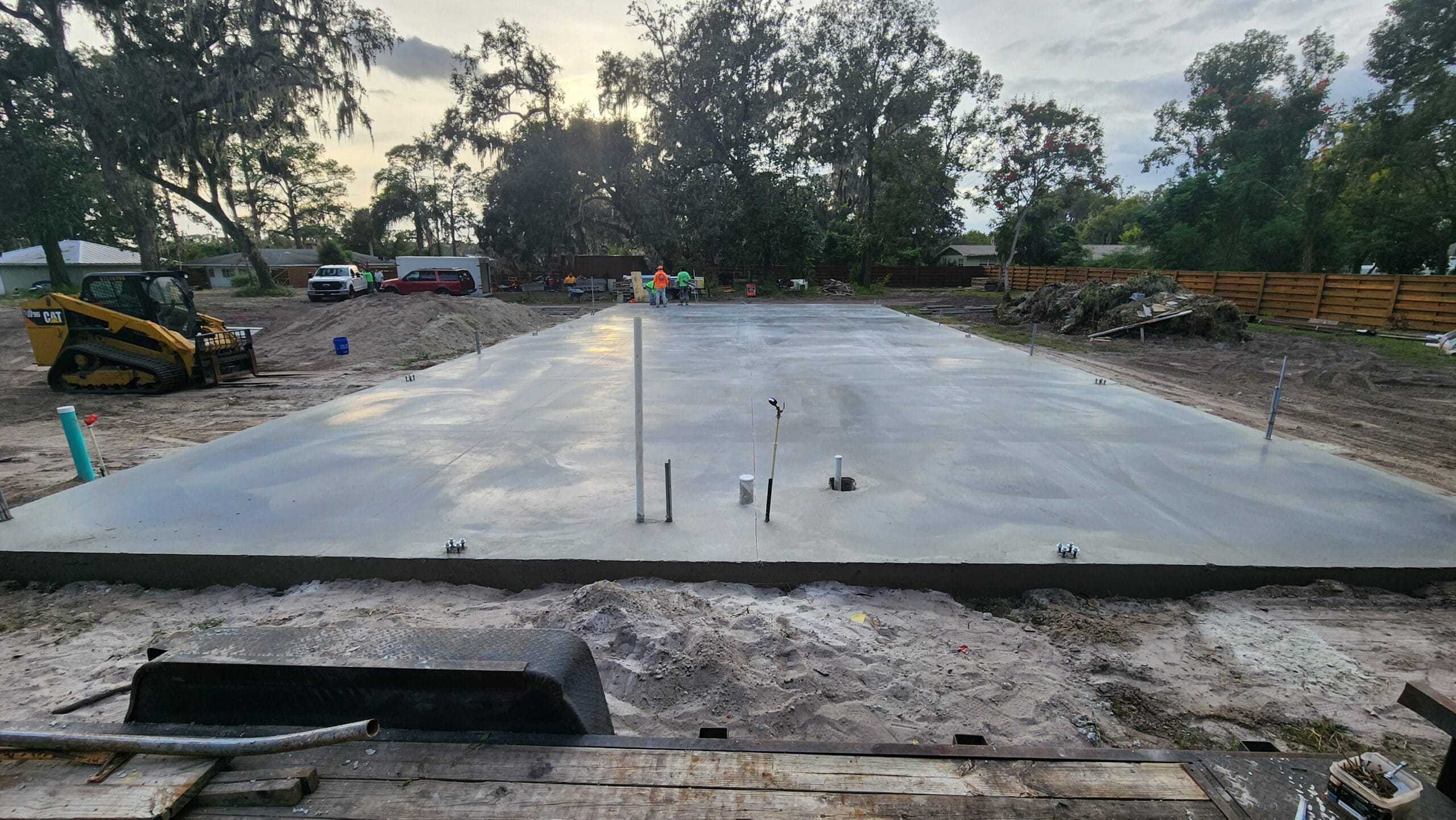
    The concrete slab foundation represents the most common choice for steel buildings, and for good reason. A properly designed slab provides both the foundation and the floor system in a single pour, creating a cost-effective solution that works well for most applications.

    Design and Construction Details

    Monolithic slab designs combine the footer and floor into one continuous pour. These work exceptionally well in stable soil conditions and warmer climates without deep frost concerns. The integrated approach reduces labor costs and construction time while creating a smooth, level surface ready for immediate use.

    The slab typically requires 4-6 inches of thickness for most agricultural and commercial applications, though heavy equipment or vehicle traffic may justify 6-8 inches. Proper reinforcement using rebar or wire mesh prevents cracking as the concrete cures and settles. The edges thicken to 12-18 inches to create a footer that distributes the column loads effectively.

    Site Preparation and Installation

    Proper site preparation makes the difference between a slab that lasts decades and one that cracks within months. The site must be excavated to remove organic material and unstable soils. A compacted gravel base, typically 4-6 inches deep, provides drainage and prevents settlement. Vapor barriers beneath the concrete prevent moisture migration that can damage stored materials or create condensation issues inside the building.

    Modern slabs often incorporate insulation beneath the concrete in climate zones with significant heating or cooling requirements. This detail improves energy efficiency and comfort while preventing heat loss through the slab. The additional cost typically pays for itself through reduced utility bills over the building’s lifetime.

    Anchoring and Drainage Considerations

    Anchor bolts embedded in the slab perimeter secure the building’s base angle to the foundation. These bolts must be precisely positioned according to the manufacturer’s anchor bolt plan. Even small positioning errors can create installation challenges or compromise the building’s structural performance. Many contractors use templates or jigs to ensure accurate placement during the pour.

    Proper drainage around the slab prevents water accumulation that can undermine the foundation or create moisture problems inside the building. The site should slope away from the building in all directions. Gutters and downspouts should direct roof drainage well away from the foundation perimeter.

    Slab foundations work exceptionally well for most steel building applications. They provide excellent value, quick construction, and reliable performance when properly designed and installed. The main limitations involve challenging soil conditions or sites with significant slope, where alternative foundation types may prove more practical.

    Pier and Beam Foundation

    Pier and beam foundations elevate the building above ground level using concrete piers or poured columns that support the steel structure. This approach offers significant advantages in specific situations where slab foundations prove impractical or unnecessarily expensive.

    When Pier Foundations Make Sense

    The pier system places concrete supports directly beneath each column load point. These piers extend below the frost line and bear on stable soil or bedrock. The building’s steel columns attach to anchor bolts embedded in the pier tops, creating a solid connection that transfers loads efficiently.

    This foundation type excels in areas with problematic soils. Expansive clays that wreak havoc on slabs cause minimal issues with pier foundations since the piers can be designed to move slightly with soil expansion and contraction. Sites with high water tables or seasonal flooding benefit from the elevated design that keeps the building above potential water damage.

    Sloped sites often make pier foundations the most economical choice. Cutting and filling to create a level building pad for a slab foundation becomes expensive on steep terrain. Piers can accommodate grade changes efficiently, following the natural topography while maintaining proper building elevation.

    The elevated design creates a crawl space beneath the building that provides several benefits. Utilities can route through this space easily, simplifying plumbing, electrical, and HVAC installations. The airflow beneath the building reduces moisture accumulation and allows for natural ventilation. Future modifications or repairs become simpler when systems remain accessible.

    Design and Installation Requirements

    However, pier foundations require additional consideration for the floor system. Most applications need a separate floor structure, typically using wood joists and plywood decking or concrete slab on grade between the piers. This additional component adds cost compared to slab foundations where the floor and foundation integrate into one system.

    The spacing between piers depends on your building’s column spacing and load requirements. Typical spacing ranges from 20 to 40 feet, determined by your building’s engineering. Each pier requires excavation, forms, rebar reinforcement, and concrete placement. The labor-intensive process takes more time than pouring a single slab.

    Frost depth requirements still apply to pier foundations. In cold climates, piers must extend below the frost line to prevent heaving. This depth varies by location, from 12 inches in southern regions to 48 inches or more in northern climates. Local building codes specify the required depth for your area.

    Stem Wall Foundation

    Stem wall foundations combine elements of both slab and pier approaches, creating a hybrid system that works well in specific applications. This foundation type uses a continuous perimeter wall that sits on a concrete footer, with the interior floor area filled to create a slab surface.

    Construction Process

    The construction process begins with trenching around the building perimeter to the required depth for your climate and soil conditions. A concrete footer, typically 12-24 inches wide and 8-12 inches thick, pours in these trenches to create the base for the stem wall. Rebar reinforcement in the footer provides tensile strength and prevents cracking.

    The stem wall itself rises from the footer to the desired floor elevation. This wall is typically 8-12 inches wide, constructed using either poured concrete or concrete masonry units (CMU blocks). The height varies based on site conditions, grade requirements, and your preference for how far above ground level the building sits.

    Once the stem wall cures, the interior area fills with compacted gravel, and the floor slab pours inside the perimeter. This approach creates a monolithic floor similar to a standard slab foundation but with the added benefits of the elevated, reinforced perimeter wall.

    Advantages and Cost Considerations

    Stem wall foundations excel in areas with moderate frost concerns where a full basement isn’t necessary but some protection from frost heaving is desirable. The design also works well on slightly sloped sites where a stem wall can accommodate grade changes more easily than a monolithic slab.

    The perimeter wall provides excellent protection against water intrusion, creating a barrier between exterior grade and the interior floor. Proper waterproofing on the exterior wall face, combined with foundation drains, keeps water away from the building interior even in wet climates.

    This foundation type costs more than simple slab foundations due to the additional excavation, forming, and concrete work required for the stem wall. However, it typically costs less than pier and beam systems while offering some similar benefits. The additional expense often justifies itself in challenging site conditions or when the elevated perimeter provides specific advantages for your application.

    Foundation Cost Breakdown

    Understanding foundation costs helps you budget accurately and make informed decisions about design options. While every project differs based on size, location, and specific requirements, some general cost ranges provide useful planning guidance.

    Slab Foundation Costs

    Concrete slab foundations typically range from $4 to $8 per square foot for basic installations in straightforward soil conditions. A 60×80 building (4,800 square feet) might cost $19,200 to $38,400 for the slab foundation. This wide range reflects regional labor cost differences, concrete prices, and site-specific factors like accessibility and site preparation requirements.

    The basic slab cost includes site excavation, gravel base, vapor barrier, concrete, reinforcement, and finishing. Additional features increase the total cost. Thickened edges for heavy loads, perimeter insulation for energy efficiency, embedded radiant heating systems, and decorative finishes all add to the base price. Factor these options into your initial budget planning rather than discovering cost overruns during construction.

    Pier and Stem Wall Foundation Costs

    Pier and beam foundations cost varies with the number of piers required and the depth needed for your frost line and soil conditions. Individual piers typically cost $200 to $600 each including excavation, forms, concrete, and rebar. A building requiring 20 piers might need $4,000 to $12,000 just for the pier work. Add the cost of a separate floor system, and total foundation costs often exceed slab foundations by 30-50%.

    Stem wall foundations generally cost 25-40% more than simple slabs due to the additional forming, concrete, and labor. Using the same 60×80 building example, expect foundation costs between $24,000 and $48,000. The premium buys specific advantages in frost protection, water management, and grade accommodation.

    Site Conditions and Additional Expenses

    Site conditions dramatically affect foundation costs. Poor soils requiring removal and replacement, high water tables needing drainage systems, or rocky conditions requiring special excavation equipment all increase expenses significantly. Budget for a professional soil test early in planning. The $500-1,500 investment in soil testing often saves thousands by identifying problems before construction begins.

    Permitting and engineering fees add to foundation costs. Most jurisdictions require engineered foundation plans for commercial structures. Engineering fees typically range from $500 to $2,000 depending on project complexity. Building permits vary widely by location but generally cost 1-3% of construction value. Some areas also require separate foundation inspections at multiple stages, adding inspector fees to your budget.

    Regional factors create significant cost variations. Urban areas with higher labor rates and strict permitting processes typically cost more than rural areas. Areas with winter construction limitations may charge premium rates for cold-weather concrete work. Coastal regions often require additional engineering for soil and wind conditions, increasing design costs.

    Smart builders obtain multiple quotes from qualified concrete contractors. Price differences of 20-30% between contractors aren’t unusual. However, foundation work isn’t the place to automatically choose the lowest bidder. Poor foundation installation creates problems that cost far more to correct than you saved initially. Check references, verify proper licensing and insurance, and ensure contractors understand steel building foundation requirements specifically.

    Soil Testing and Site Preparation

    Your foundation’s performance depends heavily on what lies beneath it. Skipping proper soil testing ranks among the most common and costly mistakes in steel building construction. Professional soil analysis identifies conditions affecting foundation design and reveals potential problems before they become expensive failures.

    Understanding Soil Reports

    A geotechnical engineer conducts soil testing by taking samples at various depths across your building site. The testing analyzes soil composition, bearing capacity, moisture content, and expansion potential. The resulting soil report provides specific recommendations for foundation design, including required depths, reinforcement needs, and special provisions for challenging conditions.

    Soil bearing capacity determines how much weight the soil can support without excessive settlement. Sandy and gravelly soils typically offer excellent bearing capacity, often supporting 2,000-3,000 pounds per square foot or more. Clay soils vary dramatically, with some types supporting substantial loads while others compress significantly under weight. The soil report specifies the bearing capacity your foundation design must accommodate.

    Special Soil and Climate Considerations

    Expansive soils present particular challenges for steel buildings. These clay-based soils swell significantly when wet and shrink when dry, creating movement that can crack slabs, shift piers, and stress building connections. The soil report identifies expansion potential and recommends mitigation strategies like deeper foundations, flexible connections, or soil stabilization.

    High water tables require special attention in foundation design. Standing water or saturated soils reduce bearing capacity and can cause settlement issues. The foundation may need to extend deeper to reach more stable soil, or the design might incorporate drainage systems to lower the water table around the foundation. In extreme cases, the site may require filling to raise the building above problematic water levels.

    Frost depth requirements vary by climate zone. Soil expands when moisture freezes, creating powerful heaving forces that can lift and crack foundations. Your foundation must extend below the maximum frost penetration depth for your area. This depth ranges from zero in frost-free southern climates to 48 inches or more in northern regions. Local building codes specify required frost depths.

    Proper Site Preparation Steps

    Proper site preparation begins before concrete work starts. Clear the building area of vegetation, topsoil, and debris. Organic materials decompose over time, creating voids beneath foundations that lead to settlement. Remove all organic matter and unstable soils, replacing them with compacted structural fill when necessary.

    Rough grading establishes proper drainage patterns and creates the level building pad your foundation requires. The site should slope away from the building in all directions to prevent water accumulation. In some cases, swales or drainage systems may be necessary to manage water flow across the property.

    Compaction of base materials critically affects foundation performance. The gravel base beneath a slab foundation must be thoroughly compacted to prevent settlement. Each lift of gravel should be 4-6 inches thick and compacted to at least 95% of maximum density before adding the next lift. Renting a plate compactor or vibratory roller ensures proper compaction that hand tamping cannot achieve.

    Engineering and Code Compliance

    Steel building foundations require engineering that accounts for the unique load patterns and connection requirements of pre-engineered metal buildings. Your building manufacturer provides engineering drawings showing exact anchor bolt locations, load reactions at each column, and specific foundation requirements.

    Foundation Engineering Requirements

    The anchor bolt plan forms the critical connection between foundation and building. These drawings show precise dimensions locating each anchor bolt relative to the building’s grid lines. Position accuracy matters enormously because the building’s base angle must align perfectly with the anchor bolts during erection. Positioning errors of even an inch can prevent proper installation or create stress concentrations that affect structural performance.

    Foundation drawings specify concrete strength requirements, typically 3,000 to 4,000 PSI for most steel building applications. Higher strength concrete costs more but provides greater durability and load capacity. Understanding proper concrete mix design and curing procedures ensures your foundation meets these specifications. The specified strength isn’t optional; your building’s engineering assumes the foundation meets these requirements. Using lower strength concrete voids warranties and creates liability issues.

    Reinforcement specifications ensure the foundation resists cracking and distributes loads properly. Rebar placement, sizing, and spacing all follow engineering requirements. Wire mesh offers adequate reinforcement for light-duty slabs, but heavier applications require rebar grids. The steel reinforcement must be properly positioned within the concrete, typically 2-3 inches from the bottom surface for effective tension resistance.

    Local building codes overlay manufacturer requirements with additional jurisdiction-specific provisions. Some areas require deeper frost footings than standard engineering assumes. Seismic zones mandate special anchoring provisions. Hurricane regions need enhanced uplift resistance. Your foundation design must satisfy both the manufacturer’s engineering and local code requirements.

    Permits and Inspection Process

    The building permit process verifies code compliance before construction begins. Submit foundation plans to your local building department, allowing adequate time for review. Plan review can take anywhere from a few days to several weeks, depending on department workload and project complexity. Don’t schedule concrete work until you receive permit approval.

    Foundation inspections occur at specific construction stages. Most jurisdictions require inspection of excavation and formwork before concrete placement, ensuring proper depth, dimensions, and anchor bolt positioning. A second inspection verifies the completed foundation meets approved plans. Schedule inspections in advance and don’t proceed to the next construction phase until receiving approval.

    Working with qualified professionals ensures code compliance and proper engineering. Use concrete contractors experienced specifically with steel building foundations. The precise anchor bolt positioning and unique load patterns differ from residential work. Contractors familiar with metal buildings understand these requirements and avoid common installation errors.

    Consider hiring a third-party inspection service for additional quality assurance. These professional inspectors verify proper installation techniques, correct material usage, and compliance with engineering specifications. The modest cost often prevents expensive problems discovered during final building inspection or, worse, after the building is complete.

    Common Foundation Mistakes to Avoid

    Even with proper planning, certain mistakes occur frequently enough to warrant special attention. Avoiding these errors saves time, money, and frustration.

    Skipping soil testing to save a few hundred dollars often leads to foundation failures costing thousands to correct. Unknown soil conditions create problems that proper testing identifies before construction begins.

    Incorrect anchor bolt positioning prevents proper building alignment during erection. The steel structure can’t compensate for positioning errors. Use templates or jigs to ensure accuracy.

    Inadequate drainage allows water to undermine foundations and create interior moisture problems. Grade sites to slope away from buildings and install proper roof drainage systems.

    Using lower concrete strength than specified compromises load capacity and durability. Always order the specified strength and verify with delivery tickets.

    Insufficient base compaction leads to settlement and cracking. Thoroughly compact each lift of gravel base before adding more material.

    Ignoring frost depth requirements causes foundation heaving in cold climates. Extend footings below maximum frost penetration depth as specified by local codes.

    Starting without permits creates legal liability and can require removing completed work. Always obtain proper permits before beginning foundation work.

    Poor construction timing in extreme weather affects concrete curing. Plan foundation work for appropriate conditions and use proper hot-weather or cold-weather concrete practices when necessary.

    Frequently Asked Questions

    Do I really need a soil test for my steel building foundation?

    Yes, professional soil testing is essential for proper foundation design. Soil conditions vary dramatically even within small areas, and unexpected problems like expansive clay or poor bearing capacity can cause foundation failures. The $500-1,500 investment in soil testing often prevents thousands in repair costs by identifying issues before construction begins.

    How thick should my concrete slab be for a steel building?

    Most agricultural and light commercial steel buildings require 4-6 inches of concrete slab thickness. Buildings with heavy equipment, vehicle traffic, or substantial storage loads may need 6-8 inches. Your building’s engineering specifies the required thickness based on your intended use and load requirements. The thickened perimeter footer is typically 12-18 inches deep to distribute column loads properly.

    Can I use an existing slab for my new steel building?

    Existing slabs can work if they meet several criteria. The slab must be level, structurally sound without significant cracking or settlement, properly sized for your new building, and have anchor points positioned to match your building’s column layout. Most existing slabs don’t meet all requirements, particularly the critical anchor bolt positioning. Have your building manufacturer’s engineer evaluate the existing slab before assuming it’s suitable.

    What’s the difference between a monolithic slab and a floating slab?

    A monolithic slab combines the footer and floor into one continuous pour, with thickened edges around the perimeter that extend below frost line. A floating slab sits on top of the ground on a gravel base without deep footers. Monolithic slabs work for most steel building applications in stable soils. Floating slabs may be suitable for temporary structures or very light buildings in frost-free climates but typically aren’t appropriate for permanent steel buildings.

    How long does concrete need to cure before building erection?

    Concrete reaches approximately 70% of its final strength in seven days and 90% in 28 days. Most steel building erection can proceed safely after 7-10 days of curing in normal weather conditions. However, anchor bolts must not be disturbed during curing, and any column loads should wait until the concrete reaches adequate strength. Your building manufacturer and concrete contractor can provide specific timing recommendations for your project.

    Do I need a vapor barrier under my concrete slab?

    Yes, vapor barriers are essential beneath concrete slabs to prevent moisture migration from the ground into your building. Place a 6-mil polyethylene sheet or specialized vapor barrier over the compacted gravel base before pouring concrete. Overlap seams by 12 inches and seal with tape. This simple step prevents condensation problems and protects stored materials from ground moisture.

    Make Your Foundation Decision With Confidence

    Your steel building deserves a foundation engineered for long-term performance and value. The choices you make during foundation planning affect your building’s structural integrity, warranty compliance, and total project cost.

    Start by obtaining professional soil testing to understand your site conditions. Work with your building manufacturer’s engineering team to design a foundation appropriate for your specific application. Choose qualified contrSteel Building Foundation Guide: Types, Costs, and Requirements

    Sarah’s 60×80 equipment storage building was three weeks from delivery when her contractor called with bad news. The foundation they’d planned wouldn’t work. The soil report revealed expansive clay requiring a completely different approach, adding $18,000 to the budget and delaying the project by six weeks.

    “Nobody told me I needed a soil test,” Sarah said. “I thought all foundations were basically the same.”

    They’re not. Your foundation represents roughly 15-25% of your total steel building project cost, and choosing the wrong type creates problems that are expensive to fix later. More importantly, your building’s structural warranty often depends on proper foundation design and installation.

    The good news? Understanding your foundation options before you break ground prevents costly surprises and ensures your steel building performs exactly as engineered for decades to come.


    Understanding Steel Building Foundation Requirements

    Steel buildings place different demands on foundations than traditional wood frame construction. The concentrated load points where columns meet the ground create specific engineering requirements that standard residential foundation approaches don’t always address properly.

    Every steel building foundation must accomplish three critical functions: distribute the building’s weight to prevent settling, resist uplift forces from wind and seismic activity, and maintain level support to preserve the building’s structural integrity. These aren’t just good practices; they’re essential for maintaining your manufacturer’s warranty and meeting building codes.

    The foundation requirements for your specific project depend on several factors. Your building’s size and intended use determine the load calculations. A 40×60 agricultural storage building creates very different foundation demands than a 100×200 manufacturing facility with heavy equipment and crane systems.

    Local soil conditions matter enormously. Sandy soils require a different foundation design than clay soils or bedrock. Areas with high water tables need additional drainage considerations. Regions experiencing freeze-thaw cycles must account for frost depth requirements to prevent heaving and cracking.

    Your climate zone affects more than just frost depth. Seismic zones require additional anchoring provisions. Hurricane-prone areas need foundations engineered for substantial uplift resistance. Snow load regions may require deeper footers to support the additional roof load during winter months.

    Building codes vary significantly by jurisdiction. Some municipalities accept engineer-stamped drawings without question. Others require extensive plan review and multiple inspections throughout the foundation installation process. Understanding your local requirements early prevents permit delays and ensures compliance.


    Foundation Types for Steel Buildings

    Choosing the right foundation type balances performance requirements, soil conditions, budget constraints, and construction timeline. Each foundation type offers distinct advantages and limitations worth understanding before you commit to one approach.

    Concrete Slab Foundation

    The concrete slab foundation represents the most common choice for steel buildings, and for good reason. A properly designed slab provides both the foundation and the floor system in a single pour, creating a cost-effective solution that works well for most applications.

    Design and Construction Details

    Monolithic slab designs combine the footer and floor into one continuous pour. These work exceptionally well in stable soil conditions and warmer climates without deep frost concerns. The integrated approach reduces labor costs and construction time while creating a smooth, level surface ready for immediate use.

    The slab typically requires 4-6 inches of thickness for most agricultural and commercial applications, though heavy equipment or vehicle traffic may justify 6-8 inches. Proper reinforcement using rebar or wire mesh prevents cracking as the concrete cures and settles. The edges thicken to 12-18 inches to create a footer that distributes the column loads effectively.

    Site Preparation and Installation

    Proper site preparation makes the difference between a slab that lasts decades and one that cracks within months. The site must be excavated to remove organic material and unstable soils. A compacted gravel base, typically 4-6 inches deep, provides drainage and prevents settlement. Vapor barriers beneath the concrete prevent moisture migration that can damage stored materials or create condensation issues inside the building.

    Modern slabs often incorporate insulation beneath the concrete in climate zones with significant heating or cooling requirements. This detail improves energy efficiency and comfort while preventing heat loss through the slab. The additional cost typically pays for itself through reduced utility bills over the building’s lifetime.

    Anchoring and Drainage Considerations

    Anchor bolts embedded in the slab perimeter secure the building’s base angle to the foundation. These bolts must be precisely positioned according to the manufacturer’s anchor bolt plan. Even small positioning errors can create installation challenges or compromise the building’s structural performance. Many contractors use templates or jigs to ensure accurate placement during the pour.

    Proper drainage around the slab prevents water accumulation that can undermine the foundation or create moisture problems inside the building. The site should slope away from the building in all directions. Gutters and downspouts should direct roof drainage well away from the foundation perimeter.

    Slab foundations work exceptionally well for most steel building applications. They provide excellent value, quick construction, and reliable performance when properly designed and installed. The main limitations involve challenging soil conditions or sites with significant slope, where alternative foundation types may prove more practical.

    Pier and Beam Foundation

    Pier and beam foundations elevate the building above ground level using concrete piers or poured columns that support the steel structure. This approach offers significant advantages in specific situations where slab foundations prove impractical or unnecessarily expensive.

    When Pier Foundations Make Sense

    The pier system places concrete supports directly beneath each column load point. These piers extend below the frost line and bear on stable soil or bedrock. The building’s steel columns attach to anchor bolts embedded in the pier tops, creating a solid connection that transfers loads efficiently.

    This foundation type excels in areas with problematic soils. Expansive clays that wreak havoc on slabs cause minimal issues with pier foundations since the piers can be designed to move slightly with soil expansion and contraction. Sites with high water tables or seasonal flooding benefit from the elevated design that keeps the building above potential water damage.

    Sloped sites often make pier foundations the most economical choice. Cutting and filling to create a level building pad for a slab foundation becomes expensive on steep terrain. Piers can accommodate grade changes efficiently, following the natural topography while maintaining proper building elevation.

    The elevated design creates a crawl space beneath the building that provides several benefits. Utilities can route through this space easily, simplifying plumbing, electrical, and HVAC installations. The airflow beneath the building reduces moisture accumulation and allows for natural ventilation. Future modifications or repairs become simpler when systems remain accessible.

    Design and Installation Requirements

    However, pier foundations require additional consideration for the floor system. Most applications need a separate floor structure, typically using wood joists and plywood decking or concrete slab on grade between the piers. This additional component adds cost compared to slab foundations where the floor and foundation integrate into one system.

    The spacing between piers depends on your building’s column spacing and load requirements. Typical spacing ranges from 20 to 40 feet, determined by your building’s engineering. Each pier requires excavation, forms, rebar reinforcement, and concrete placement. The labor-intensive process takes more time than pouring a single slab.

    Frost depth requirements still apply to pier foundations. In cold climates, piers must extend below the frost line to prevent heaving. This depth varies by location, from 12 inches in southern regions to 48 inches or more in northern climates. Local building codes specify the required depth for your area.

    Stem Wall Foundation

    Stem wall foundations combine elements of both slab and pier approaches, creating a hybrid system that works well in specific applications. This foundation type uses a continuous perimeter wall that sits on a concrete footer, with the interior floor area filled to create a slab surface.

    Construction Process

    The construction process begins with trenching around the building perimeter to the required depth for your climate and soil conditions. A concrete footer, typically 12-24 inches wide and 8-12 inches thick, pours in these trenches to create the base for the stem wall. Rebar reinforcement in the footer provides tensile strength and prevents cracking.

    The stem wall itself rises from the footer to the desired floor elevation. This wall is typically 8-12 inches wide, constructed using either poured concrete or concrete masonry units (CMU blocks). The height varies based on site conditions, grade requirements, and your preference for how far above ground level the building sits.

    Once the stem wall cures, the interior area fills with compacted gravel, and the floor slab pours inside the perimeter. This approach creates a monolithic floor similar to a standard slab foundation but with the added benefits of the elevated, reinforced perimeter wall.

    Advantages and Cost Considerations

    Stem wall foundations excel in areas with moderate frost concerns where a full basement isn’t necessary but some protection from frost heaving is desirable. The design also works well on slightly sloped sites where a stem wall can accommodate grade changes more easily than a monolithic slab.

    The perimeter wall provides excellent protection against water intrusion, creating a barrier between exterior grade and the interior floor. Proper waterproofing on the exterior wall face, combined with foundation drains, keeps water away from the building interior even in wet climates.

    This foundation type costs more than simple slab foundations due to the additional excavation, forming, and concrete work required for the stem wall. However, it typically costs less than pier and beam systems while offering some similar benefits. The additional expense often justifies itself in challenging site conditions or when the elevated perimeter provides specific advantages for your application.


    Foundation Cost Breakdown

    Understanding foundation costs helps you budget accurately and make informed decisions about design options. While every project differs based on size, location, and specific requirements, some general cost ranges provide useful planning guidance.

    Slab Foundation Costs

    Concrete slab foundations typically range from $4 to $8 per square foot for basic installations in straightforward soil conditions. A 60×80 building (4,800 square feet) might cost $19,200 to $38,400 for the slab foundation. This wide range reflects regional labor cost differences, concrete prices, and site-specific factors like accessibility and site preparation requirements.

    The basic slab cost includes site excavation, gravel base, vapor barrier, concrete, reinforcement, and finishing. Additional features increase the total cost. Thickened edges for heavy loads, perimeter insulation for energy efficiency, embedded radiant heating systems, and decorative finishes all add to the base price. Factor these options into your initial budget planning rather than discovering cost overruns during construction.

    Pier and Stem Wall Foundation Costs

    Pier and beam foundations cost varies with the number of piers required and the depth needed for your frost line and soil conditions. Individual piers typically cost $200 to $600 each including excavation, forms, concrete, and rebar. A building requiring 20 piers might need $4,000 to $12,000 just for the pier work. Add the cost of a separate floor system, and total foundation costs often exceed slab foundations by 30-50%.

    Stem wall foundations generally cost 25-40% more than simple slabs due to the additional forming, concrete, and labor. Using the same 60×80 building example, expect foundation costs between $24,000 and $48,000. The premium buys specific advantages in frost protection, water management, and grade accommodation.

    Site Conditions and Additional Expenses

    Site conditions dramatically affect foundation costs. Poor soils requiring removal and replacement, high water tables needing drainage systems, or rocky conditions requiring special excavation equipment all increase expenses significantly. Budget for a professional soil test early in planning. The $500-1,500 investment in soil testing often saves thousands by identifying problems before construction begins.

    Permitting and engineering fees add to foundation costs. Most jurisdictions require engineered foundation plans for commercial structures. Engineering fees typically range from $500 to $2,000 depending on project complexity. Building permits vary widely by location but generally cost 1-3% of construction value. Some areas also require separate foundation inspections at multiple stages, adding inspector fees to your budget.

    Regional factors create significant cost variations. Urban areas with higher labor rates and strict permitting processes typically cost more than rural areas. Areas with winter construction limitations may charge premium rates for cold-weather concrete work. Coastal regions often require additional engineering for soil and wind conditions, increasing design costs.

    Smart builders obtain multiple quotes from qualified concrete contractors. Price differences of 20-30% between contractors aren’t unusual. However, foundation work isn’t the place to automatically choose the lowest bidder. Poor foundation installation creates problems that cost far more to correct than you saved initially. Check references, verify proper licensing and insurance, and ensure contractors understand steel building foundation requirements specifically.


    Soil Testing and Site Preparation

    Your foundation’s performance depends heavily on what lies beneath it. Skipping proper soil testing ranks among the most common and costly mistakes in steel building construction. Professional soil analysis identifies conditions affecting foundation design and reveals potential problems before they become expensive failures.

    Understanding Soil Reports

    A geotechnical engineer conducts soil testing by taking samples at various depths across your building site. The testing analyzes soil composition, bearing capacity, moisture content, and expansion potential. The resulting soil report provides specific recommendations for foundation design, including required depths, reinforcement needs, and special provisions for challenging conditions.

    Soil bearing capacity determines how much weight the soil can support without excessive settlement. Sandy and gravelly soils typically offer excellent bearing capacity, often supporting 2,000-3,000 pounds per square foot or more. Clay soils vary dramatically, with some types supporting substantial loads while others compress significantly under weight. The soil report specifies the bearing capacity your foundation design must accommodate.

    Special Soil and Climate Considerations

    Expansive soils present particular challenges for steel buildings. These clay-based soils swell significantly when wet and shrink when dry, creating movement that can crack slabs, shift piers, and stress building connections. The soil report identifies expansion potential and recommends mitigation strategies like deeper foundations, flexible connections, or soil stabilization.

    High water tables require special attention in foundation design. Standing water or saturated soils reduce bearing capacity and can cause settlement issues. The foundation may need to extend deeper to reach more stable soil, or the design might incorporate drainage systems to lower the water table around the foundation. In extreme cases, the site may require filling to raise the building above problematic water levels.

    Frost depth requirements vary by climate zone. Soil expands when moisture freezes, creating powerful heaving forces that can lift and crack foundations. Your foundation must extend below the maximum frost penetration depth for your area. This depth ranges from zero in frost-free southern climates to 48 inches or more in northern regions. Local building codes specify required frost depths.

    Proper Site Preparation Steps

    Proper site preparation begins before concrete work starts. Clear the building area of vegetation, topsoil, and debris. Organic materials decompose over time, creating voids beneath foundations that lead to settlement. Remove all organic matter and unstable soils, replacing them with compacted structural fill when necessary.

    Rough grading establishes proper drainage patterns and creates the level building pad your foundation requires. The site should slope away from the building in all directions to prevent water accumulation. In some cases, swales or drainage systems may be necessary to manage water flow across the property.

    Compaction of base materials critically affects foundation performance. The gravel base beneath a slab foundation must be thoroughly compacted to prevent settlement. Each lift of gravel should be 4-6 inches thick and compacted to at least 95% of maximum density before adding the next lift. Renting a plate compactor or vibratory roller ensures proper compaction that hand tamping cannot achieve.


    Engineering and Code Compliance

    Steel building foundations require engineering that accounts for the unique load patterns and connection requirements of pre-engineered metal buildings. Your building manufacturer provides engineering drawings showing exact anchor bolt locations, load reactions at each column, and specific foundation requirements.

    Foundation Engineering Requirements

    The anchor bolt plan forms the critical connection between foundation and building. These drawings show precise dimensions locating each anchor bolt relative to the building’s grid lines. Position accuracy matters enormously because the building’s base angle must align perfectly with the anchor bolts during erection. Positioning errors of even an inch can prevent proper installation or create stress concentrations that affect structural performance.

    Foundation drawings specify concrete strength requirements, typically 3,000 to 4,000 PSI for most steel building applications. Higher strength concrete costs more but provides greater durability and load capacity. Understanding proper concrete mix design and curing procedures ensures your foundation meets these specifications. The specified strength isn’t optional; your building’s engineering assumes the foundation meets these requirements. Using lower strength concrete voids warranties and creates liability issues.

    Reinforcement specifications ensure the foundation resists cracking and distributes loads properly. Rebar placement, sizing, and spacing all follow engineering requirements. Wire mesh offers adequate reinforcement for light-duty slabs, but heavier applications require rebar grids. The steel reinforcement must be properly positioned within the concrete, typically 2-3 inches from the bottom surface for effective tension resistance.

    Local building codes overlay manufacturer requirements with additional jurisdiction-specific provisions. Some areas require deeper frost footings than standard engineering assumes. Seismic zones mandate special anchoring provisions. Hurricane regions need enhanced uplift resistance. Your foundation design must satisfy both the manufacturer’s engineering and local code requirements.

    Permits and Inspection Process

    The building permit process verifies code compliance before construction begins. Submit foundation plans to your local building department, allowing adequate time for review. Plan review can take anywhere from a few days to several weeks, depending on department workload and project complexity. Don’t schedule concrete work until you receive permit approval.

    Foundation inspections occur at specific construction stages. Most jurisdictions require inspection of excavation and formwork before concrete placement, ensuring proper depth, dimensions, and anchor bolt positioning. A second inspection verifies the completed foundation meets approved plans. Schedule inspections in advance and don’t proceed to the next construction phase until receiving approval.

    Working with qualified professionals ensures code compliance and proper engineering. Use concrete contractors experienced specifically with steel building foundations. The precise anchor bolt positioning and unique load patterns differ from residential work. Contractors familiar with metal buildings understand these requirements and avoid common installation errors.

    Consider hiring a third-party inspection service for additional quality assurance. These professional inspectors verify proper installation techniques, correct material usage, and compliance with engineering specifications. The modest cost often prevents expensive problems discovered during final building inspection or, worse, after the building is complete.


    Common Foundation Mistakes to Avoid

    Even with proper planning, certain mistakes occur frequently enough to warrant special attention. Avoiding these errors saves time, money, and frustration.

    Skipping soil testing to save a few hundred dollars often leads to foundation failures costing thousands to correct. Unknown soil conditions create problems that proper testing identifies before construction begins.

    Incorrect anchor bolt positioning prevents proper building alignment during erection. The steel structure can’t compensate for positioning errors. Use templates or jigs to ensure accuracy.

    Inadequate drainage allows water to undermine foundations and create interior moisture problems. Grade sites to slope away from buildings and install proper roof drainage systems.

    Using lower concrete strength than specified compromises load capacity and durability. Always order the specified strength and verify with delivery tickets.

    Insufficient base compaction leads to settlement and cracking. Thoroughly compact each lift of gravel base before adding more material.

    Ignoring frost depth requirements causes foundation heaving in cold climates. Extend footings below maximum frost penetration depth as specified by local codes.

    Starting without permits creates legal liability and can require removing completed work. Always obtain proper permits before beginning foundation work.

    Poor construction timing in extreme weather affects concrete curing. Plan foundation work for appropriate conditions and use proper hot-weather or cold-weather concrete practices when necessary.


    Frequently Asked Questions

    Do I really need a soil test for my steel building foundation?

    Yes, professional soil testing is essential for proper foundation design. Soil conditions vary dramatically even within small areas, and unexpected problems like expansive clay or poor bearing capacity can cause foundation failures. The $500-1,500 investment in soil testing often prevents thousands in repair costs by identifying issues before construction begins.

    How thick should my concrete slab be for a steel building?

    Most agricultural and light commercial steel buildings require 4-6 inches of concrete slab thickness. Buildings with heavy equipment, vehicle traffic, or substantial storage loads may need 6-8 inches. Your building’s engineering specifies the required thickness based on your intended use and load requirements. The thickened perimeter footer is typically 12-18 inches deep to distribute column loads properly.

    Can I use an existing slab for my new steel building?

    Existing slabs can work if they meet several criteria. The slab must be level, structurally sound without significant cracking or settlement, properly sized for your new building, and have anchor points positioned to match your building’s column layout. Most existing slabs don’t meet all requirements, particularly the critical anchor bolt positioning. Have your building manufacturer’s engineer evaluate the existing slab before assuming it’s suitable.

    What’s the difference between a monolithic slab and a floating slab?

    A monolithic slab combines the footer and floor into one continuous pour, with thickened edges around the perimeter that extend below frost line. A floating slab sits on top of the ground on a gravel base without deep footers. Monolithic slabs work for most steel building applications in stable soils. Floating slabs may be suitable for temporary structures or very light buildings in frost-free climates but typically aren’t appropriate for permanent steel buildings.

    How long does concrete need to cure before building erection?

    Concrete reaches approximately 70% of its final strength in seven days and 90% in 28 days. Most steel building erection can proceed safely after 7-10 days of curing in normal weather conditions. However, anchor bolts must not be disturbed during curing, and any column loads should wait until the concrete reaches adequate strength. Your building manufacturer and concrete contractor can provide specific timing recommendations for your project.

    Do I need a vapor barrier under my concrete slab?

    Yes, vapor barriers are essential beneath concrete slabs to prevent moisture migration from the ground into your building. Place a 6-mil polyethylene sheet or specialized vapor barrier over the compacted gravel base before pouring concrete. Overlap seams by 12 inches and seal with tape. This simple step prevents condensation problems and protects stored materials from ground moisture.


    Make Your Foundation Decision With Confidence

    Your steel building deserves a foundation engineered for long-term performance and value. The choices you make during foundation planning affect your building’s structural integrity, warranty compliance, and total project cost.

    Start by obtaining professional soil testing to understand your site conditions. Work with qualified engineers to design a foundation appropriate for your specific application. Choose experienced contractors familiar with steel building foundations, and ensure all work receives proper permits and inspections.

    Ready to start planning your steel building project? Contact MBMI today for a consultation about your commercial steel building needs. Our team can discuss your project requirements and connect you with the right resources to ensure your building performs exactly as designed for decades to come.From agricultural buildings to commercial warehouses, our steel building company provides the systems that serve as the foundation for your success.

  • Pre-Engineered vs Custom Steel Buildings: Which Is Right for You?

    Pre-Engineered vs Custom Steel Buildings: Which Is Right for You?

    Two business owners, same industry, same building size. Jim chose pre-engineered. Sarah went custom. Both got exactly what they needed, but their journeys couldn’t have been more different.

    Jim runs an equipment rental business and needed a 60×100 storage building fast. His requirements were straightforward: weather protection, vehicle access, and minimal cost. He selected a pre-engineered system, received his building in eight weeks, and came in 20% under budget. Mission accomplished.

    Sarah operates a specialty manufacturing facility requiring precise temperature control, overhead crane systems, and future expansion capability. She initially worried that pre-engineered buildings couldn’t handle her specialized needs, but MBMI’s customizable pre-engineered systems delivered exactly the functionality her business demanded while maintaining cost efficiency and faster delivery than fully custom alternatives.

    The right choice isn’t always the obvious one. Understanding when each approach delivers better value requires looking beyond initial price tags to examine total project requirements, long-term flexibility, and real-world performance needs.

    Understanding the Fundamental Differences

    What’s the difference between pre-engineered and custom steel buildings? Pre-engineered buildings utilize standardized design systems with proven load tables, connection details, and component specifications. These systems can be extensively customized and modified to meet specific site conditions, architectural requirements, and performance needs while maintaining the efficiency of proven engineering approaches.

    Fully custom buildings start with blank engineering analysis for every component. However, most projects that appear “custom” actually use modified pre-engineered systems that have been adapted so extensively they seem custom-designed. This approach combines the cost efficiency of pre-engineered systems with the flexibility to meet unique requirements.

    At MBMI, our pre-engineered metal buildings can be customized to an extent that they often appear fully custom while maintaining the cost and timeline advantages of proven engineering systems. Our in-house engineering team can modify spans, heights, loads, architectural features, and specialized requirements within our flexible pre-engineered platform.

    Cost Analysis Beyond the Price Tag

    Pre-engineered buildings typically cost 15-25% less than fully custom alternatives, and this advantage often increases when extensive customization is required. Advanced pre-engineered systems like MBMI’s can accommodate complex modifications while maintaining cost efficiency through proven engineering platforms and streamlined manufacturing processes.

    However, upfront costs tell only part of the story. The key is distinguishing between companies that offer limited standard buildings with expensive modification charges versus those that specialize in customizable pre-engineered systems designed for extensive adaptation.

    When customizable pre-engineered systems provide better value than fully custom: Projects requiring specialized features often benefit from pre-engineered platforms that have been designed from the ground up to accommodate modifications. This approach delivers custom functionality at pre-engineered pricing.

    Hidden costs in basic pre-engineered systems often surface when simple modifications require extensive re-engineering. Standard systems not designed for customization can become expensive quickly when clients need features beyond basic parameters. This explains why choosing a company with robust customization capabilities matters more than initial price comparisons.

    MBMI’s customizable pre-engineered approach provides cost predictability because our systems are designed to accommodate modifications efficiently. Our in-house engineering team can evaluate customization requirements upfront and provide accurate pricing without the surprises that often accompany basic pre-engineered systems pushed beyond their intended capabilities.

    Long-term value considerations strongly favor customizable pre-engineered buildings that can adapt to changing needs without requiring complete replacement. The ability to modify or expand buildings efficiently provides operational flexibility that justifies any initial investment differences over the building’s lifetime.

    Timeline Expectations and Reality

    Pre-engineered manufacturing typically requires 6-10 weeks from order to delivery, and this timeline advantage often extends to heavily customized pre-engineered buildings. Companies like MBMI with robust customization capabilities can accommodate extensive modifications while maintaining faster delivery than fully custom alternatives.

    Fully custom design and manufacturing can extend timelines to 12-20 weeks or more, depending on project complexity and the need for completely original engineering analysis. The additional time reflects the requirement to engineer every component from scratch rather than adapting proven systems.

    Why customizable pre-engineered systems maintain timeline advantages relates to their foundation on proven engineering platforms. Even extensive modifications work within established structural frameworks, allowing faster engineering analysis and manufacturing coordination than fully custom approaches.

    The AISC Design Guides provide comprehensive resources for structural steel design decisions and help set realistic expectations for both approaches. Understanding these industry standards helps prevent timeline disappointment and allows proper project coordination.

    How long does it take to build a customizable pre-engineered steel building? Total project time from order to building completion typically ranges 3-5 months for customized pre-engineered buildings, compared to 5-8 months for fully custom structures. The difference becomes more pronounced as customization requirements increase.

    Construction timelines often favor customizable pre-engineered buildings because components arrive precisely manufactured for specific requirements without the extensive field coordination often required for fully custom systems. MBMI’s manufacturing precision reduces construction delays and ensures proper fit of the various components.

    What Really Matters: Flexibility vs Speed

    Here’s what most people get wrong about pre-engineered buildings: they assume severe limitations. The reality? Modern customizable systems like MBMI’s can handle clear spans over 200 feet, specialized crane loads, and complex architectural features while maintaining the speed and cost advantages that make pre-engineered attractive in the first place.

    The question isn’t whether you can get what you need from pre-engineered systems. The question is whether you’re working with a company that has invested in truly flexible platforms or one that sells basic buildings with expensive modification upcharges.

    MBMI’s customizable systems accommodate:

    • Clear spans exceeding 200 feet
    • Building heights over 50 feet
    • Heavy crane systems and specialized loads
    • Custom architectural features and branding elements
    • Complex site conditions and unusual requirements

    Traditional limitations only apply when working with companies offering basic pre-engineered buildings designed decades ago. Modern systems like MBMI’s were engineered from the ground up to handle extensive customization efficiently.

    Perfect Applications for Each Approach

    Customizable pre-engineered excels for: Nearly everything. Warehouses, manufacturing facilities, aircraft hangars, retail centers, agricultural buildings, and mixed-use projects all benefit from the flexibility and efficiency of advanced pre-engineered systems.

    Fully custom alternatives exist, but rarely provide better value. Some clients prefer the perception of “custom” engineering, but MBMI’s customizable systems deliver the same functionality more efficiently through proven platforms that have been refined over decades.

    The bottom line: MBMI’s engineering capabilities can accommodate any project requirement through our flexible pre-engineered systems. The question isn’t whether we can handle your needs – it’s whether you want the efficiency advantages that come with our proven approach.

    Your Decision Made Simple

    Start here: Can MBMI’s customizable pre-engineered systems handle your requirements? The answer is yes, even for complex projects that initially require fully custom solutions.

    Budget considerations: Customizable pre-engineered delivers custom functionality at pre-engineered pricing. Even heavily modified systems typically cost 20-30% less than fully custom alternatives while completing faster.

    Timeline pressure: Customizable pre-engineered maintains 3-5 month project timelines even with extensive modifications. Fully custom projects often extend 6-8 months or longer.

    Future flexibility: MBMI’s systems are designed for future expansion and modification, providing operational adaptability without the limitations of basic pre-engineered buildings.

    The decision framework is simpler than most people think: customizable, pre-engineered handles projects more efficiently than fully custom alternatives. 

    Making the Right Choice for Your Project

    Here’s the reality: MBMI’s customizable pre-engineered systems handle virtually any building requirement more efficiently than fully custom alternatives. The decision isn’t really about choosing between approaches – it’s about working with a company that has the engineering capabilities to deliver what you need.

    Three questions to ask yourself:

    1. Do you want to pay more and wait longer for fully custom engineering when customizable pre-engineered delivers the same results?
    2. Does your timeline allow 6-8 months for fully custom, or do you prefer 3-5 months with customizable systems?
    3. Are you working with a company that has invested in truly flexible platforms, or one trying to modify basic systems beyond their capabilities?

    The choice becomes obvious when you understand that modern customizable pre-engineered systems can accommodate any requirement while maintaining significant cost and timeline advantages. The key is choosing the right engineering partner, not the right building category.

    Contact MBMI today to explore what’s possible with modern, customizable pre-engineered systems. Our engineering team will evaluate your specific requirements and show you the most efficient path to achieving your project goals.

    Don’t let outdated assumptions about pre-engineered limitations prevent you from getting the building you need at a price that makes sense. MBMI’s advanced systems deliver custom results through proven, efficient processes.

  • Commercial Steel Buildings vs Tilt-Up Construction: Pros, Cons, and Use Cases

    Commercial Steel Buildings vs Tilt-Up Construction: Pros, Cons, and Use Cases

    When planning a commercial structure, one of the first critical decisions developers face is the construction method. The two most common systems in large-scale commercial construction are commercial steel buildings vs. tilt-up construction.

    Both methods are proven, but each has distinct strengths, challenges, and suitability depending on project requirements. Your choice affects not only upfront cost and construction speed but also long-term performance, flexibility, and total cost of ownership.


    What is Tilt-Up Construction?

    Tilt-up construction involves casting large concrete wall panels horizontally on the building site itself. Once cured, these panels are “tilted” upright using cranes and braced into position. The remaining structure (roof framing, interior framing, doors, and finishes) is then completed around these walls.

    This method is often favored for projects that require large, simple footprints with smooth concrete exterior walls, such as warehouses, distribution centers, and large retail stores.

    However, tilt-up relies heavily on weather conditions, site access, and precise sequencing. The panels must cure properly on-site, which can extend timelines during periods of rain, cold, or humidity. Additionally, tilt-up requires large work areas for laying out and casting panels and heavy equipment for lifting them into place.


    What is a Pre-Engineered Commercial Steel Building?

    Pre-engineered commercial steel buildings (PEMBs) are systems where the building’s frame, roof, and wall panels are fabricated in a factory before being shipped to the jobsite. These buildings arrive ready for efficient assembly by a trained erection crew, reducing on-site labor time and minimizing weather-related delays.

    PEMBs are incredibly versatile and are commonly used for warehouses, manufacturing facilities, service centers, agricultural structures, and flexible multi-use spaces. At MBMI, we design pre-engineered buildings that are highly customizable, allowing owners to tailor dimensions, framed openings, insulation packages, and finishes to their specific operational needs.


    Pros and Cons of Tilt-Up Construction

    Tilt-up construction has several clear advantages. The solid concrete walls provide inherent fire resistance and durability and are capable of supporting large clear spans for open interior spaces. The smooth concrete finish may appeal to developers seeking a minimalist, modern exterior aesthetic.

    However, there are drawbacks. The concrete panels require substantial, reinforced foundations to support their weight, which adds to cost and complexity. Tilt-up is also more labor-intensive on-site, with many steps dependent on perfect weather conditions. Any rain, excessive heat, or humidity can delay the curing process or complicate pours, pushing timelines out.

    Another limitation is flexibility: once complete, a tilt-up structure is difficult and expensive to modify or expand. Future renovations involving additional doors, windows, or changes to wall configurations often require specialized demolition and patchwork that detracts from the clean original design.


    Pros and Cons of Commercial Steel Buildings

    Pre-engineered commercial steel buildings deliver a compelling set of benefits for commercial owners and developers. One of the most important advantages is speed of construction. Since components are fabricated off-site in controlled conditions, erection can begin immediately upon delivery. Construction timelines are predictable and shorter, which reduces total labor costs.

    Steel buildings also require lighter foundations due to the material’s superior strength-to-weight ratio. This reduces excavation and concrete requirements, making steel a preferred option for sites with challenging soil conditions or where foundation costs could escalate.

    Design flexibility is another hallmark of steel buildings. Framed openings can be located almost anywhere in the structure, interior layouts can be reconfigured easily, and expansions are relatively simple. Many owners plan for future additions at the outset.

    That said, steel buildings do have some limitations. The exterior finish may require architectural cladding if a premium aesthetic is desired, adding to cost. And like all metal buildings, they must be properly sealed and maintained to prevent corrosion over the long term.

    Overall, when comparing commercial steel buildings vs tilt-up construction, steel buildings typically offer faster delivery, lower construction costs, and greater adaptability for changing business needs.


    Factors to Consider When Choosing

    Choosing between these two systems requires careful thought about your project’s specific needs.

    If your timeline is compressed, a steel building’s rapid fabrication and efficient assembly will help meet your schedule. If labor costs or weather variability are concerns, steel’s off-site prefabrication reduces exposure to those risks.

    If aesthetics demand smooth concrete finishes or local fire codes require certain wall assemblies, tilt-up may make sense. But if your project could benefit from future expansion or needs a building envelope that can adapt over time, steel is far superior.

    Cost is a critical consideration. Steel buildings often offer a lower total installed cost, not only because of shorter construction times but also due to savings on foundations and smaller on-site crews. Tilt-up can be more expensive upfront, especially when soil conditions or weather issues demand additional work.

    Finally, think about the building’s future. Can your structure serve your needs today and adapt as those needs change? In many cases, steel’s flexibility makes it the better investment over time.


    Why Steel is Often the Smarter Choice

    In many commercial applications, pre-engineered steel buildings deliver faster return on investment thanks to reduced construction times, lower labor costs, and adaptability for future growth.

    Where tilt-up construction excels in large-scale, permanent warehouses or distribution centers with strict fire-resistance requirements and no anticipated modifications, steel buildings dominate when speed, flexibility, and scalability matter.

    MBMI’s steel buildings can be tailored to meet both aesthetic and performance needs, incorporating high-quality trim and flashing, insulation packages, and architectural options that ensure lasting performance.


    Final Thought

    The decision between commercial steel buildings vs tilt-up construction is more than a cost comparison. It’s about selecting a system that fits your project’s timeline, budget, site conditions, and long-term business goals.

    For most commercial and industrial applications, steel buildings deliver a smarter, faster, and more flexible solution. When you need guidance on your next project, MBMI’s team is ready to help you design a structure that meets your needs today and can evolve with you tomorrow.

    Contact MBMI today to discuss your options and get expert advice tailored to your project requirements.

  • Steel Building Essentials: The Value of Fully Insulated Walk Doors

    Steel Building Essentials: The Value of Fully Insulated Walk Doors

    A small detail with major commercial impact

    In commercial construction, details matter. While it’s easy to focus on structural steel, roof spans, or foundation requirements, the truth is that comfort, security, and operational efficiency often hinge on something as modest as a walk door.

    For our custom metal building company, walk doors are not an afterthought. They’re fully insulated, built to perform, and included as a standard in every building package, and that decision is entirely deliberate. In the context of a commercial structure, a walk door is not simply a point of entry. It’s an essential feature that impacts everything from energy management to code compliance and day-to-day usability.

    Here’s why this small yet mighty component deserves a closer look.

    Insulated Entry Points Matter More Than You Think

    In any structure that requires temperature stability, and that includes a surprising range of steel building types, entry doors are a known weak point. A poorly sealed or uninsulated door allows air infiltration that can undermine an otherwise well-insulated building.

    MBMI’s fully insulated walk doors are designed to combat exactly that. Each door features:

    • A solid, insulated core for thermal resistance
    • Rust-resistant construction that holds up in humid and coastal climates
    • A tight seal that reduces drafts and energy loss
    • Pre-installed hardware for quick, secure installation

    Combined with our commercial metal building insulation packages, these doors help form a consistent building envelope that supports HVAC performance and reduces energy bills. This is especially important in:

    • Commercial steel buildings where clients and employees expect climate control
    • Barndominiums and live/work spaces where year-round comfort matters
    • Steel riding arenas where controlling dust and moisture is essential
    • Agricultural steel buildings that protect temperature-sensitive equipment or feed
    • RV storage buildings where air-tight sealing prevents condensation and corrosion

    Whether your structure is built for people, products, or livestock, climate protection starts with the envelope, and walk doors are a key part of that.

    Built to Handle Daily Use

    Steel buildings are often built for hard use. In most commercial and agricultural settings, doors aren’t used once or twice a day, they’re in near-constant operation. That’s why MBMI’s doors are designed for heavy-duty, high-traffic performance.

    Standard features include:

    • Durable steel skins that resist dents and warping
    • Full insulation to prevent thermal bridging
    • Pre-hung frames that simplify installation and alignment
    • Rust-proof hardware built to withstand extreme weather

    Whether you’re running a commercial warehouse, an equestrian training facility, or an RV park with a steel garage, you need access points that don’t compromise under pressure. MBMI’s walk doors are made to function like the rest of our structures; reliably, quietly, and without interruption.

    Security and Compliance from the Ground Up

    Access control and code compliance are critical in commercial and multi-use buildings. A walk door isn’t just a way in, it’s also a boundary for what comes in and out.

    MBMI’s walk doors are engineered with this in mind. They:

    • Support commercial-grade locking systems and ADA-compliant hardware
    • Meet typical code requirements for egress, accessibility, and safety
    • Resist forced entry and environmental intrusion

    That means one less inspection concern, fewer code adjustments, and more peace of mind for clients who need functional security without extra planning or upgrades.

    Seamless Integration for a Professional Finish

    For customers building offices, storefronts, or barndominiums, appearances still matter. MBMI’s walk doors include matching trim that blends with your building’s exterior for a clean, professional finish. Because the door is included and pre-engineered into the building package, there’s no need for custom retrofits or patchwork trim jobs.

    The result is a building that looks just as refined as it is functional, from first impressions to final inspection.

    One More Reason MBMI is the Best Steel Building Company

    Some providers treat walk doors as upgrades or optional components. At MBMI, we include them as standard because we know they belong in every serious steel building design. We believe that quality isn’t just about frames and panels, it’s about every single part of the structure, including how you get in and out.

    Our clients trust us with agricultural steel buildings, barndominiums, riding arenas, mini-storage facilities, and a full range of commercial projects. Across all of them, walk doors are essential to performance, compliance, and comfort, which is why we build them to last and include them from the start.


    Final Thought

    Fully insulated walk doors may not be the biggest component in your steel building, but they’re one of the most important. They keep climates controlled, protect what matters inside, and help your building meet modern standards for usability and efficiency.

    If you’re planning a steel structure for commercial, residential, or agricultural use, make sure your walk doors are built for more than just entry; make sure they’re built for performance.

    At MBMI, they are.

  • 40 Years of Confidence: The Science Behind MBMI’s High-Gloss Panels

    40 Years of Confidence: The Science Behind MBMI’s High-Gloss Panels

    You don’t promise 40 years of protection unless you can back it up.

    At MBMI Metal Buildings, that confidence isn’t just marketing. It’s engineered into every panel we produce. For decades, our customers have trusted that their buildings will stand strong, resist rust, and keep their color, even after years of blazing sun and brutal weather.

    So what’s the secret behind that kind of staying power?

    The answer lies in a carefully layered process that combines metallurgical science with high-performance finishes and an unwavering focus on quality.

    The Core of It All: Galvalume® Steel

    Every long-lasting panel begins with the right foundation. At our metal building company, that foundation is Galvalume®, a steel substrate coated in a precise mixture of 55% aluminum and 45% zinc.

    The aluminum acts as a barrier, shielding the steel from environmental exposure, while the zinc provides sacrificial protection. That means even if the surface is scratched or damaged, the surrounding zinc will corrode first, essentially “taking the hit” to keep rust from spreading.

    It’s a smart, self-preserving system. And it’s one of the biggest reasons our high-gloss panels continue performing after decades in the field.

    Gloss and Grit: The Role of Premium Paint Systems

    Of course, structure is only part of the story. What really sets MBMI panels apart is what you see and what you don’t.

    Our high-gloss paint systems don’t just offer aesthetic appeal. They’re built for performance, using PVDF (polyvinylidene fluoride) coatings that are renowned in the metal building industry for one thing: endurance.

    These finishes use ceramic-based pigments that are chemically stable and highly resistant to UV breakdown. That means less fading, less surface wear, and more visual integrity over time.

    We’re not talking about a few extra years. We’re talking about decades of color stability, even in areas with intense sun exposure.

    No Room for Chalk

    One of the most frustrating signs of aging panels is chalking. That dusty white residue that builds up over time and dulls the look of a building. It happens when resins break down under UV light and moisture, leaving powdery particles on the surface.

    To combat this, MBMI’s coatings include high-grade resins specifically selected for their chalking resistance. These resins stay strong, maintaining both the finish and the clean, professional appearance our customers expect.

    The result? A building that still looks sharp when your neighbor’s panels have already started to show their age.

    Designed to Be Trouble-Free

    Durability at MBMI doesn’t stop with paint and metal.

    Our panel system includes premium lifetime fasteners. A detail many overlook. These fasteners match the finish of the panels and are made to resist rust, which is critical for protecting structural integrity. Cheaper fasteners might save a few dollars up front, but they often void warranties and become the first point of failure.

    We also engineer every building to meet local codes and regional demands, from coastal environments to snowy mountain towns. Our base and eave trim, larger base angles, and cable bracing aren’t just for looks. They improve stability, prevent sagging, and simplify assembly.

    In short, it’s a complete system, backed by engineering experience and built with longevity in mind.

    A Warranty That Means Something

    Our 40-year panel warranty isn’t a formality. It’s a reflection of how confident we are in our materials, coatings, and process. When customers ask how long their building will last, we don’t hesitate.

    And that kind of peace of mind? It’s engineered into every square foot.

    Built to Last. Built to Impress.

    There’s a reason customers come back to MBMI when it’s time for their next project. The shine doesn’t fade. The panels don’t chalk. The structure stays sound.

    Because when you invest in a building, you’re investing in the future. And we’re proud to build panels that are still performing strong 40 years later.

    Whether you are in the market for a barndominium, commercial metal building, agricultural steel building, or anything else, our in-house engineers can design your dream building. Contact us today for a free quote and consultation.

  • Rust-Free for Life: Why Premium Lifetime Fasteners Matter for Steel Buildings

    Rust-Free for Life: Why Premium Lifetime Fasteners Matter for Steel Buildings

    Fasteners are often overlooked components in construction, yet they bear the critical responsibility of ensuring the durability and integrity of steel buildings. Imagine a bridge held together by weak, rust-prone fasteners; the consequences would be catastrophic. This simple analogy underscores the importance of selecting high-quality, rust-proof fasteners for long-term performance and safety. 

    The Critical Role of Fasteners in Steel Buildings

    Fasteners serve as the connective tissue of steel buildings. They link structural components and panels, enabling the entire system to function cohesively. Here are some crucial points regarding their role:

    • Load-Bearing Capacity: Fasteners are essential for distributing loads throughout a structure. A poorly fastened panel can result in an uneven weight distribution, leading to structural failures.
    • Environmental Exposure: Unlike some building materials, fasteners must withstand extreme environmental stress. They face:
      • Moisture: Rain and humidity can lead to rusting.
      • Temperature Changes: Rapid shifts between warm and cold can cause expansion and contraction, putting stress on fasteners.
      • UV Exposure: Sunlight can degrade coatings on fasteners, making them susceptible to corrosion.
    • Consequences of Compromise: If a fastener fails, the resulting issues can range from minor inconveniences to significant hazards. A compromised connection can lead to leaks, structural weakness, and ultimately, safety risks to inhabitants.

    Understanding Rust and Corrosion

    Understanding the phenomenon of rust is essential for recognizing the importance of premium fasteners:

    • How Rust Forms: Rust is the product of iron reacting with oxygen in the presence of moisture. This reaction leads to iron oxide, commonly known as rust, which gradually degrades the metal’s integrity.
    • Common Causes of Rust in Fasteners: Poor-quality materials, insufficient protective coatings, and environmental factors can all lead to premature rusting. Fasteners that are not designed for sustainability in tough conditions are more likely to fail.
    • Corrosion-Resistant vs. Rust-Proof: While both types offer a degree of protection, it is vital to understand that corrosion-resistant materials may still succumb to rust over time, especially under harsh conditions. Rust-proof materials actively prevent rust formation, making them a more reliable choice for steel buildings.

    Why Premium Lifetime Fasteners Matter

    Investing in premium lifetime fasteners offers numerous advantages:

    • Rust-Proof Materials and Coatings: Premium fasteners are constructed from high-grade materials accompanied by advanced coatings designed to withstand continuous exposure to moisture, chemicals, and other corrosive elements. This bolsters their resistance to rusting.
    • Long-Term Structural Integrity: Quality fasteners maintain their strength and performance over time. This prevents degradation that could compromise safety, functionality, and load-bearing abilities. Not only do they hold components tightly, but they also safeguard against catastrophic failures.
    • Enhanced Aesthetics: Fasteners contribute to the visual aspect of a steel building. Quality fasteners not only hold panels together but also maintain a clean, polished appearance, enhancing the overall design and curb appeal.
    • Cost Savings: Investing in premium fasteners can translate to significant long-term savings. What may seem like a higher upfront cost will indeed provide value by avoiding expensive repairs or replacements resulting from rust damage down the road.

    Non-Lifetime Fasteners: The Hidden Risks

    The lure of inexpensive fasteners may seem appealing, but the risks often far outweigh the benefits. Consider the following pitfalls:

    • Premature Failure: Non-lifetime fasteners are prone to rust and degradation, leading to:
      • Structural weaknesses.
      • Unwanted leaks within panels.
      • Enhanced visual degradation that diminishes the building’s appeal.
    • Warranty Voidance: Many manufacturers do not honor warranties if non-lifetime fasteners are used. This poses significant financial risks should repairs become necessary, as the costs can skyrocket in the event of structural failure.
    • Long-Term Operational Risks: The repeated need for repairs or replacements due to substandard fasteners can disrupt business operations, financial stability, and overall productivity.

    How to Choose the Right Fasteners for Steel Buildings

    Selecting the right fasteners requires careful consideration:

    • Material Compatibility: Ensure that the fasteners you choose are compatible with the steel panels. This includes understanding the type of steel used and opting for fasteners that complement those materials.
    • Climate Considerations: Factors such as humidity, saltwater exposure, or temperature extremes can influence choice. Opt for fasteners specifically designed for your environmental challenges.
    • Consulting Experts: Engaging with industry professionals can provide insights and guidance, helping you make informed decisions that can save you time, energy, and money in the long run.

    Common Myths About Fasteners

    It’s vital to dispel the myths surrounding fasteners to make informed decisions:

    • “All fasteners are the same.” Each fastener is designed with specific materials, coatings, and uses in mind. Quality can vary dramatically.
    • “Rust-resistant is good enough.” Rust-proof fasteners provide a level of assurance that rust-resistant options cannot.
    • “Premium fasteners aren’t worth the extra cost.” Consider the long-term savings and peace of mind that come with investing in high-quality fasteners as opposed to their cheaper counterparts.

    MBMI Metal Buildings’ Premium Lifetime Fasteners

    MBMI Metal Buildings stands out in the industry due to our commitment to quality craftsmanship:

    • Key Features: We utilize guaranteed rust-proof, self-drilling, self-tapping lifetime fasteners with matching finish on all our roof and wall panels, designed to withstand environmental stressors while enhancing aesthetic values.
    • Warranty Benefits: The use of premium lifetime fasteners supports extensive warranty programs, safeguarding your investment for years and providing peace of mind to building owners.
    • Customer Testimonials: Numerous satisfied customers attest to how MBMI’s fasteners have proven their resilience, still performing effectively after many years. Real-life success stories highlight MBMI’s reliability and commitment to excellence.

    Conclusion

    In conclusion, the significance of investing in premium lifetime fasteners cannot be overstated when constructing steel buildings. Their role in ensuring longevity, maintaining warranties, and enhancing overall structural integrity is crucial. With extensive experience and a reputation for quality, we at MBMI Metal Buildings stand ready to partner with you to ensure that your steel building is rust-free and built to last.

    Don’t wait; contact MBMI today for more information or to embark on your custom steel building project. Your investment deserves nothing less than the best.

  • Designing Multi-Purpose Agricultural Steel Buildings

    Designing Multi-Purpose Agricultural Steel Buildings

    In the ever-evolving world of agriculture, the demand for adaptability and efficiency is more pressing than ever. As industry needs shift—driven by technological advancements, climate considerations, and market changes—the design of agricultural buildings must evolve in tandem. Multi-purpose agricultural steel buildings have emerged as a favored solution among farmers and agricultural enterprises, offering a versatile and efficient way to accommodate a range of activities.

    Understanding Multi-Purpose Agricultural Steel Buildings

    Defining Multi-Purpose Agricultural Buildings

    Agricultural steel buildings are versatile structures that serve various functions to support agricultural operations and business activities. These buildings are designed to accommodate equipment storage, livestock housing, crop processing, retail space, and more.

    Key Characteristics

    The versatility of these buildings allows for:

    • Flexibility: Space can be adapted based on seasonal demands, different types of livestock, or changing market needs.
    • Efficiency: The ability to utilize one structure for multiple functions reduces overhead costs and maximizes return on investment.

    The Trend Toward Versatility

    With the trend toward diversified farming practices, the ability to repurpose existing structures has become essential for agricultural businesses. For instance, a single facility may need to transition from storing equipment in the off-season to hosting a retail space during peak harvest days.

    Key Considerations in Designing Multi-Purpose Buildings

    When planning multi-purpose agricultural buildings, there are several essential factors to consider:

    Purpose Flexibility

    Designs should allow for versatile use over time. Consider incorporating modular design elements or movable internal partitions to ensure space can be transformed as needs evolve.

    Space Planning

    Optimize layout to accommodate varying agricultural activities, ensuring there are open spaces for equipment maneuvering, livestock movement, and efficient storage management.

    Zoning and Local Regulations

    Understanding zoning laws and building codes is critical to ensuring compliance and aligning with local agricultural practices. Planning should incorporate relevant regulations to avoid delays or modifications post-construction.

    Design Elements to Enhance Functionality

    Building Layout

    Effective layout design is crucial for enhancing workflow. Establish designated areas for receiving deliveries, processing crops, and storing equipment—all contributing to operational efficiency.

    Ventilation and Climate Control

    Proper ventilation plays a vital role in maintaining the well-being of livestock and crops. Consider both passive and mechanical climate control systems to optimize temperature and air quality.

    Natural Light Utilization

    Incorporate windows and skylights in the design to enhance energy efficiency and improve the welfare of workers and animals. Natural light fosters a healthier environment while reducing the dependence on artificial lighting.

    Loading and Access Considerations

    Design wide entryways and access points to facilitate efficient movement of large equipment and livestock. Strategic placement ensures smooth operations and minimizes traffic congestion in busy areas.

    Infrastructure and Utilities Integration

    An integrated approach to infrastructure and utilities must be carefully planned:

    Water Supply and Drainage

    Effective water management systems are essential for agricultural needs. Plan for efficient water supply, wastewater management, and drainage solutions that align with community regulations.

    Electrical Systems

    Adequate electrical planning is vital for powering machinery, lighting, and climate control systems. Consider the incorporation of renewable energy sources, such as solar panels, to complement energy needs sustainably.

    Internet Connectivity

    Incorporating modern technology in agricultural practices is vital for efficiency. Ensure internet connectivity is addressed, allowing for technology-driven solutions such as smart farming and real-time monitoring.

    6. Customization Options for Agricultural Steel Buildings

    Customization can help ensure that agricultural buildings are suited to specific functions:

    Available Customization Options

    Consider the following customization features:

    • Size and Layout Configurations: Tailor dimensions based on intended use—whether for livestock, equipment, or storage.
    • Color and Finish: Varied color schemes can enhance aesthetics and align with a farmer’s branding or visual preferences.

    Case Studies of Customized Multi-Purpose Buildings

    Examine examples of customized structures that demonstrate enhanced practicality for agricultural purposes, showcasing how tailored designs optimize functionality.

    Sustainability in Design

    Sustainable design practices are often the foundation for modern agricultural buildings:

    Overview of Sustainable Practices

    Implement energy-efficient systems, including:

    • Insulation and Heating/Cooling Technologies: Optimize designs to minimize heat loss and maximize energy efficiency.
    • Solar Panels and Rainwater Collection Systems: Incorporate technologies that reduce dependency on public utilities while promoting self-sufficiency.

    Benefits of Sustainable Building

    Sustainable practices benefit agriculture by reducing costs and environmental impact while improving community engagement and health outcomes.

    Future Trends in Agricultural Steel Building Design

    Staying ahead of emerging trends is crucial for agricultural efficiency:

    Smart Buildings Equipped with IoT Devices

    Incorporating smart technology into building design can streamline processes through real-time monitoring and management.

    The Use of AI and Data Analytics

    AI and data-driven insights can optimize agricultural operations—helping producers make informed decisions based on accurate data regarding yield forecasting or resource management.

    Modular and Prefabricated Solutions

    Continuing to explore modular designs allows for flexible expansion as agricultural practices grow and evolve while reducing construction waste and costs.

    Conclusion

    Designing versatile agricultural steel buildings complements modern agricultural practices while maximizing efficiency and functionality. By integrating tailored features and embracing sustainable practices, farmers can ensure their facilities adapt as needs evolve.

    Are you ready to maximize efficiency and flexibility in your agricultural operations? Contact MBMI Metal Buildings today to explore your options for designing high-quality, customizable steel buildings tailored to your unique agricultural needs. Let our expert in-house design and engineering team assist you in creating a structure that enhances your productivity and meets the demands of your evolving agricultural enterprise!